AI call transcription for sales turns a recorded phone call into searchable, quotable text, so the detail of a conversation stops living only in a rep's memory. For an Australian outbound team making dozens of calls a day, that text is what lets a manager check what was promised, a rep pick up a callback where it left off, and a new starter learn how the best calls actually sound.
Most writing on the subject jumps straight to the summary. This guide stays with the transcript itself: what it is good for, how to read one quickly, where it goes wrong, and the habits that make AI call transcription for sales worth paying for. If you want the summary side, our guide to AI call summaries for sales teams covers it.
What AI call transcription for sales actually produces
From recording to text
Transcription starts with a recording. Once a recorded call ends, the audio is passed to a speech-to-text model, which writes out what was said. A second step can then condense that text into a short summary. Nothing happens while the call is in progress: the transcript arrives after the call, and only for calls that were recorded. If a call was not recorded, there is nothing to transcribe.
A transcript is not a summary
A summary tells you the outcome in three sentences. A transcript gives you every word, in order. Each has a job. The summary is for scanning a day of calls; the transcript is for the moments when the exact words matter: the price the rep quoted, the date the prospect gave, the objection in their own phrasing, or the promise someone now disputes.
What good output looks like
A useful sales transcript has clean sentence breaks, recognisable names, and numbers written as numbers. It should sit against the call it came from, next to the recording and the outcome, not in a separate app. If your team has to export audio, upload it somewhere else and paste text back into the CRM, the transcript will be produced for a week and then forgotten.
How sales teams use call transcripts day to day
Checking what was actually said
The most common use is the simplest: settling what happened. A prospect says they were promised a discount; a rep says they offered a callback. Reading the transcript takes a minute, and listening to a six-minute recording takes six. When a detail is disputed, check the recording as well, because the audio is the original and the transcript is a copy of it.
Picking up a callback without guessing
A rep calling back a lead that a teammate spoke to last week can read the last transcript before dialling and open with the prospect's own words: "You mentioned the lease ends in March." That beats "Just following up" every time, and it removes the awkward moment where the prospect repeats their whole situation.
Building a library of real calls
A month of transcripts is a training library written by your own team, in your own market. Search the text for the calls where a rep handled "I'm already with someone" well and give those to new starters. Real Australian calls, with real suburbs and real objections, teach more than a script written for another country.
Handing over an account cleanly
Reps leave, go on holiday or move to a different patch, and their leads land on someone else's list. Without transcripts, the handover is a few lines of notes and a hope. With them, the new rep can read the last two or three conversations with each warm lead in a few minutes, see what was offered and what was declined, and avoid repeating a pitch the prospect already turned down. For a team that rotates lists between reps, this alone can justify recording.
Refining the script from the words prospects use
Prospects describe their problems in phrases your script never uses. Reading ten transcripts in a row shows which opening lines get a second sentence and which get a hang-up. For real estate agents prospecting a patch, it also shows which suburbs and property types come up again and again.
Reading transcripts well, and where they go wrong
A five-minute review routine
Here is a worked example, with assumptions stated. Suppose a manager wants to review five calls a day per rep for a four-rep team. Listening at an assumed four minutes a call is 80 minutes a day. Skimming summaries first and then reading only the two or three transcripts per rep that need attention, at an assumed one to two minutes each, brings that to roughly 20 to 30 minutes. Your call lengths and review depth will differ; the point is that text can be skimmed and audio cannot.
Names, numbers and accents
Speech-to-text models mishear unusual names, suburb names and figures, and they struggle more with crosstalk, speakerphones and noisy sites. Treat every name, street number and price in a transcript as a lead to check, not a fact to quote. Before anything goes on a contract or a quote, confirm it against the recording.
Recording consent comes first
AI call transcription for sales only works on recorded calls, so the recording has to be handled properly. In Australia, recording a phone call can be covered by the federal Telecommunications (Interception and Access) Act 1979 as well as state and territory surveillance or listening devices laws, which differ from one another. Many businesses tell the other person at the start of the call that it is being recorded. This is general information, not legal advice: get advice on what your team needs to say and do. Transcripts that contain personal information are also handled under the Australian Privacy Principles if your business is covered by the Privacy Act.
Veyce: transcription built into the dialler
Recorded calls are transcribed after they end
In Veyce's power dialler for Australian teams, recording is switched on in Settings. Calls made through your Veyce number while recording is on are recorded, and once each call ends the recording is transcribed and a short AI summary is added, typically a minute or two later. Transcription never runs during the call. Calls a rep places from their own phone, if you allow that option, are not recorded, so they have no transcript or summary.
Where the transcript lives
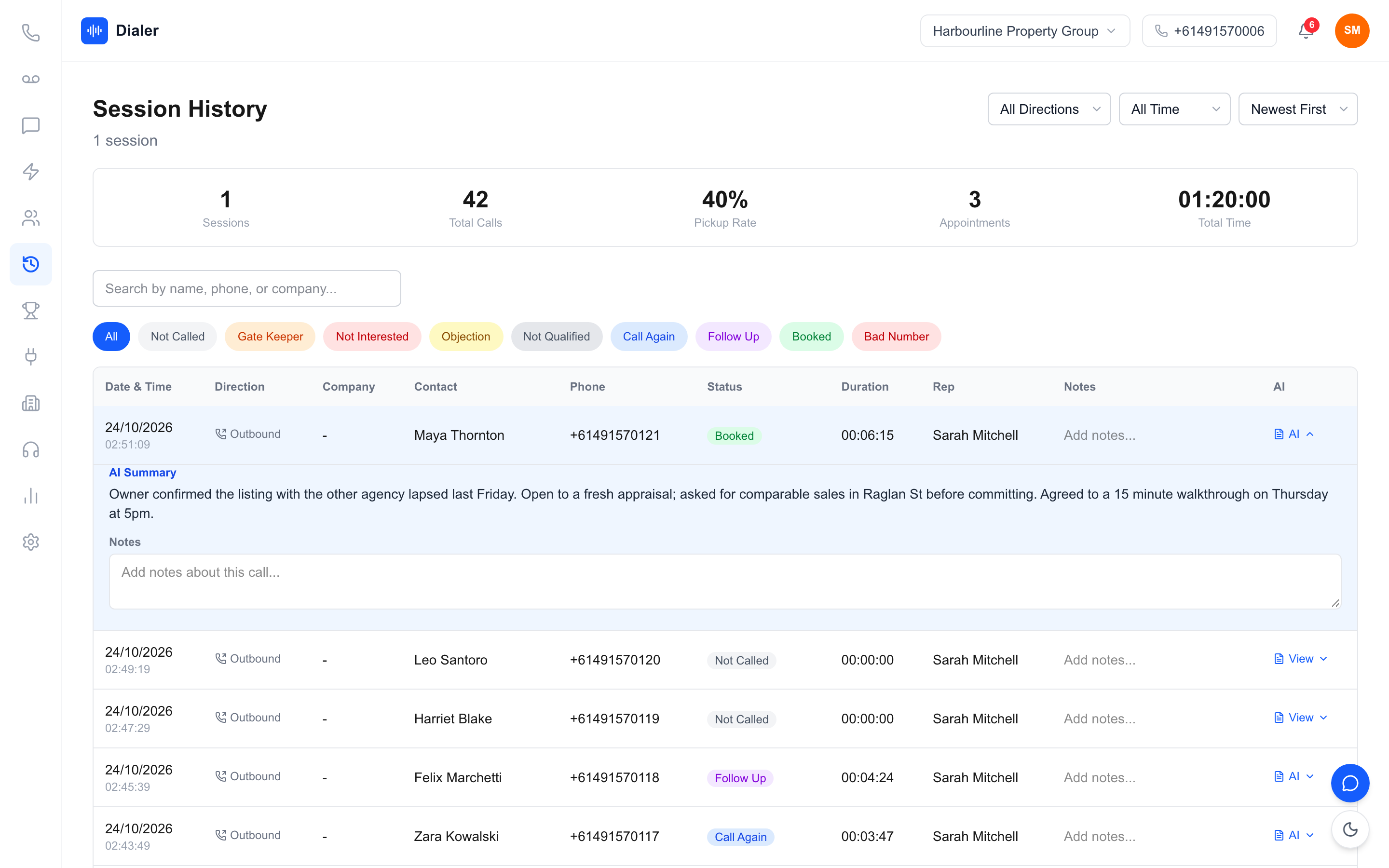
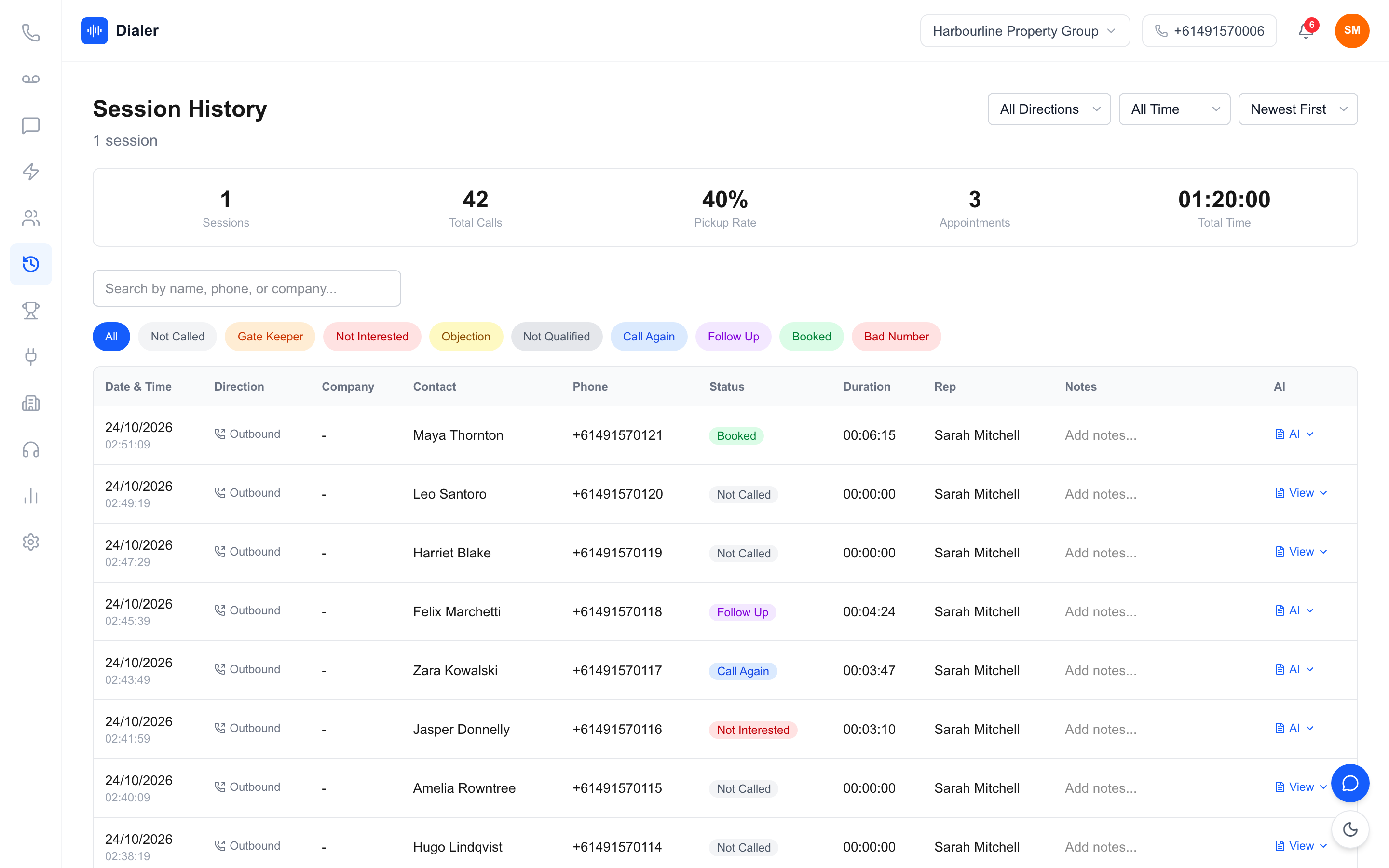
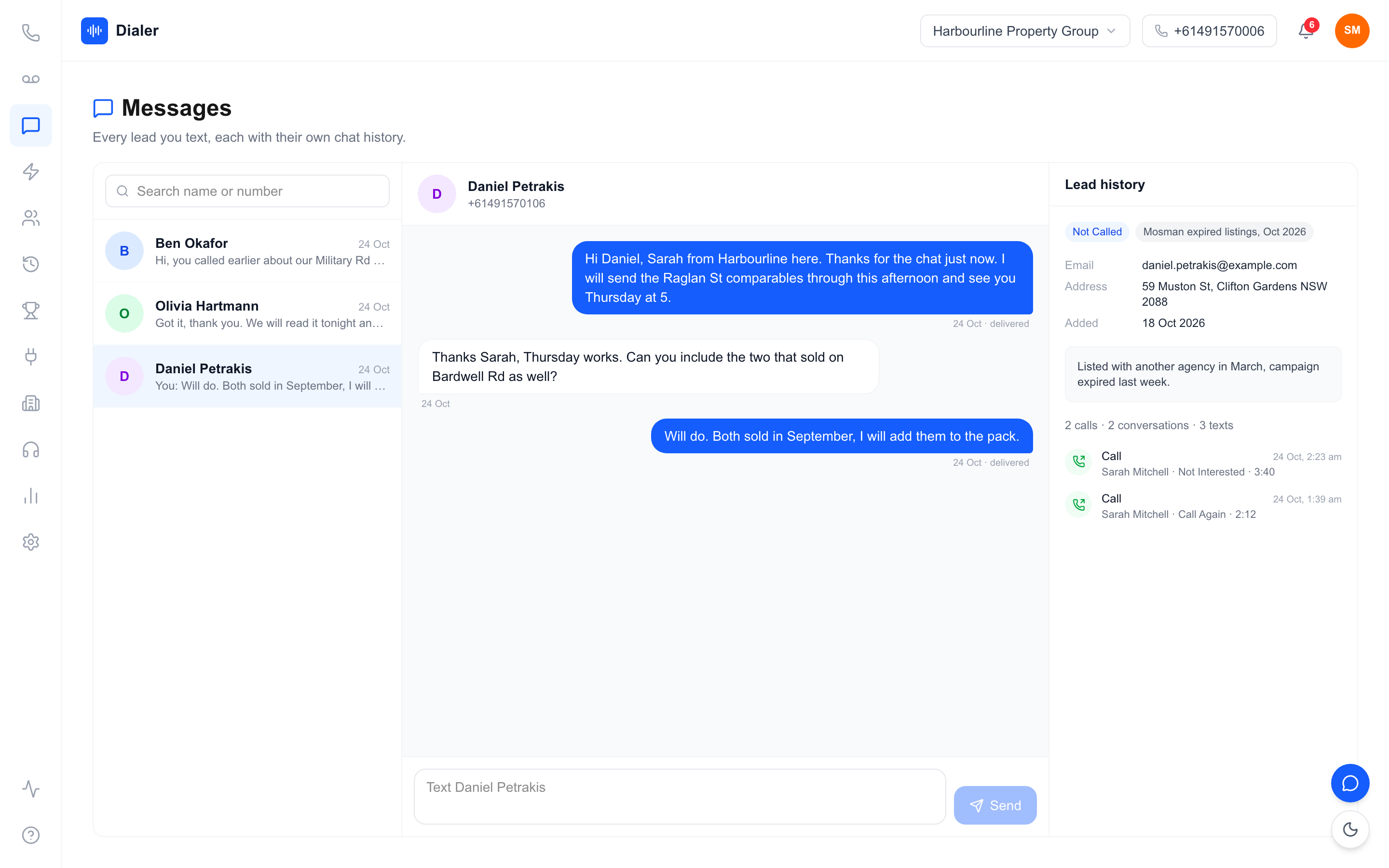
Each call in the session history carries the AI summary, the full transcript with a copy button, and a player for the recording. The summary is two or three sentences covering what the prospect said, their interest or objection, and the agreed next step. The same calls, with outcomes, summaries and recordings, also appear beside a lead's text history in Messages, so a rep can read the whole relationship in one place. To help with names, Veyce gives the transcription step the names likely to come up, such as your team and the lead, which reduces misspellings without removing them.
Who can see it, and what it costs
Recordings can only be played by signed-in members of the organisation that made the call, and Veyce does not use your recordings or transcripts to train AI models. Call recording with AI transcripts and summaries comes on the Team ($179 a month), Growth ($449) and Agency ($1,099) plans; Solo at $49 a month does not include call recording. The full list is on Veyce's pricing page.
Making AI call transcription for sales a habit
The value of AI call transcription for sales is not the text itself. It is the minute saved on every disputed detail, the callback that opens with the prospect's own words, and the library of real calls that trains the next hire. Make it routine: summaries first, transcripts for the calls that matter, the recording for anything that goes on paper.
The easiest way to judge it is on your own calls. Call recording with AI transcripts and summaries comes on the Team, Growth and Agency plans: turn recording on, make a morning of calls, and read the transcripts that afternoon to see whether the text changes how your team follows up. To try Veyce first, start a free 3-day trial, counted from your first call, with 100 calling minutes and no card, and test the dialler, lead import, scripts and session flow on your own list.
Frequently asked questions
What is AI call transcription for sales?
It is the use of a speech-to-text model to turn a recorded sales call into written text once the call has ended. Many tools then add a short AI summary of the outcome and next step. The transcript gives you every word in order, which is useful when a price, a date or a promise matters, while the summary is better for scanning a whole day of calls quickly. Both depend on the call being recorded in the first place.
Does Veyce transcribe calls while they are happening?
No. Veyce transcribes a call after it ends, and only if the call was recorded. With recording switched on in Settings, calls made through your Veyce number are recorded, and the transcript and a short AI summary are usually added to the call a minute or two after hang-up. Calls a rep places from their own phone, where that option is allowed, are not recorded, so they have no transcript or summary at all.
How accurate are AI sales call transcripts?
Accuracy depends mostly on audio quality. Clear headset audio on both sides produces clean text; speakerphones, noisy sites, crosstalk and strong background noise produce gaps and misheard words. Unusual names, suburb names and figures are the most common errors. Treat a transcript as a fast way to find the right moment in a call, then confirm any name, number or price against the recording before you rely on it for a quote or a contract.
Do I need consent to record sales calls in Australia?
Recording a phone call in Australia can be covered by the federal Telecommunications (Interception and Access) Act 1979 and by state and territory surveillance or listening devices laws, and the rules are not the same everywhere. Many businesses tell the other person at the start of the call that it is being recorded. This is general information only, so get legal advice on what your team should say and do before you start recording.
Which Veyce plans include call transcription?
Team, Growth and Agency. Call recording with AI transcripts and summaries comes on Team at $179 a month, Growth at $449 and Agency at $1,099; Solo at $49 a month does not include call recording. Each plan also includes calling minutes and a dedicated Australian number for the team. The free 3-day trial, counted from your first call, includes 100 calling minutes and does not ask for a card. Like Solo, it has no recording, so it tests the dialler, lead import, scripts and session flow on your own list.