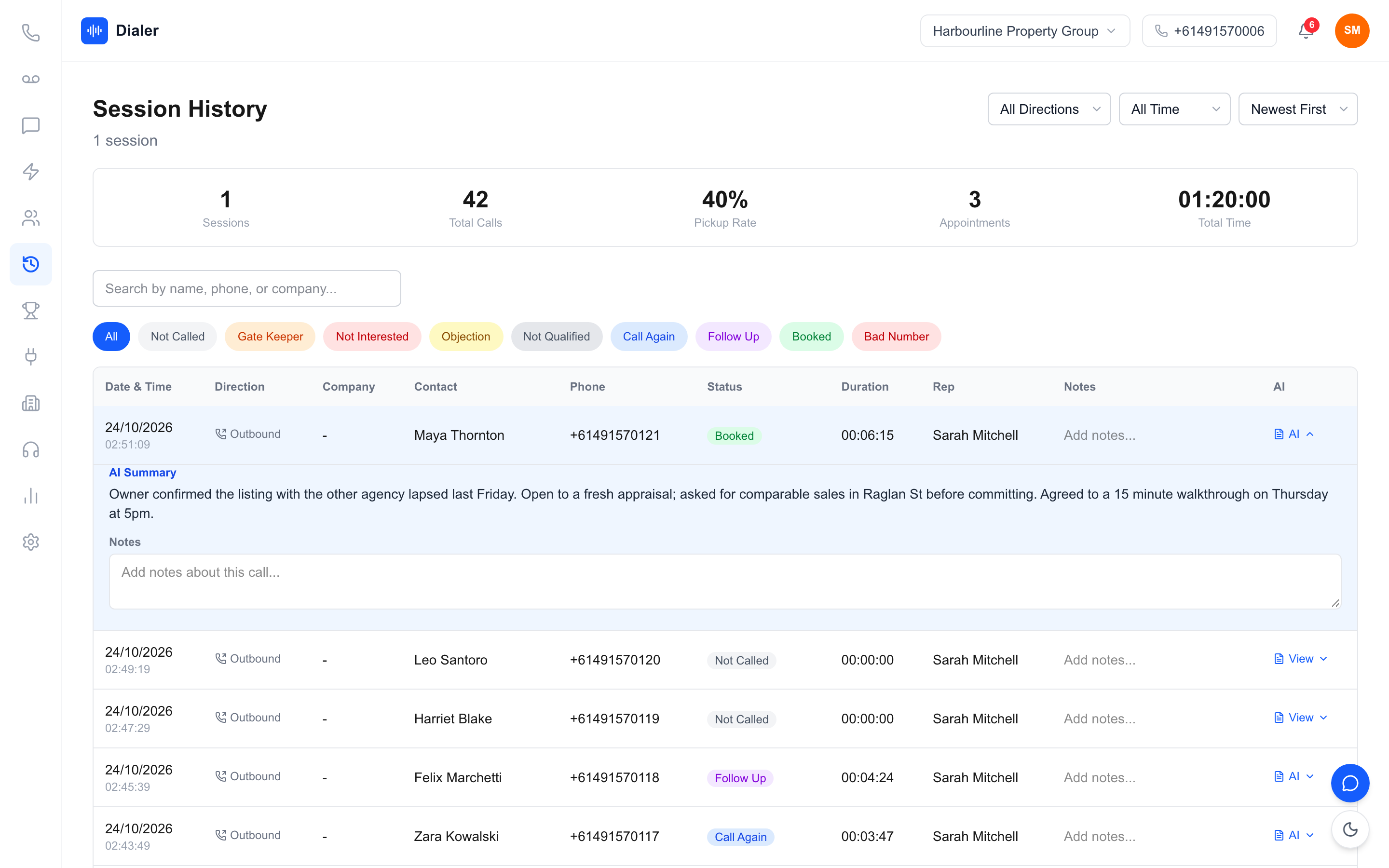
Every sales manager knows the ritual. A rep finishes a call, the outcome matters, and someone has to listen to the whole recording to find out what actually happened. Multiply that by a team making dozens of calls a day and call review becomes the first thing that quietly stops happening. AI call summaries for sales teams exist to fix exactly that: every recorded call made through your Veyce number is transcribed and condensed into a short, readable summary automatically, minutes after the call ends.
This guide explains what AI call summaries are, what a good one contains, where they fall short, and how Australian outbound teams are using them to review calls faster, clean up their CRM notes and stop losing the detail that wins the next call.
What are AI call summaries for sales teams?
An AI call summary is a short written digest of a sales call, generated automatically from the call recording. The recording is first transcribed (speech converted to text) and then a language model reads the transcript and extracts what matters: who was spoken to, what was discussed, what the customer said they need, any objections raised, the price or terms mentioned, and what was agreed as the next step.
The result replaces the two worst artefacts in sales: the unlistened recording and the rep's three-word call note ("called, no answer, try later", written for a call that actually ran six minutes). A good summary is written in plain language, takes under a minute to read, and sits against the call record so it can be found later. Well-built AI call summaries for sales teams read like notes from a sharp colleague who sat in on the call, not like a robot's book report.
What a good AI call summary contains
Not all summaries are equal. A summary that just says "the rep discussed pricing with the customer" adds nothing. The ones sales teams actually use contain:
- The outcome, up front. Connected, callback booked, not interested, gatekeeper, wrong number: stated in the first line, not buried.
- What the customer actually said. Their situation, timeline and pain points in their words, not the rep's interpretation.
- Objections, named. Price, timing, an existing supplier, "send me an email": listed specifically so patterns become visible across calls.
- Commitments made. A callback date, a quote promised, a decision-maker to include next time. Summaries that capture commitments are the ones that stop deals leaking.
- Numbers and names mentioned. Prices, dates, addresses, competitor names: the details reps forget by the third call of the hour.
If a summary does not separate what the customer said from what the rep said, treat it as a transcript with better formatting, not a summary.
Why sales teams actually use them
Managers get their review time back
Reviewing calls by listening means reviewing almost none of them. Reading summaries, a manager can scan a full day's calls for a whole team in the time one recording used to take, then listen closely only to the calls that matter: the near-miss, the big objection, the one worth sharing with the team. This is the daily habit that makes AI call summaries for sales managers more valuable than any dashboard: review becomes something that actually happens, every day, not a Friday afternoon intention.
CRM notes stop being fiction
Reps hate admin, so call notes get written late, briefly or not at all. When the summary is generated automatically from the recording, the record is complete whether the rep remembered or not. Follow-ups stop depending on memory, and a new rep taking over an account can read the history in minutes.
Objection patterns become visible
One rep hitting a price objection is a call. Every rep hitting the same price objection in the same suburb is a market signal. That pattern is invisible in recordings and obvious in summaries, because summaries can be scanned, searched and compared in a way audio never can. Teams that review AI call summaries for sales patterns weekly routinely find the one objection, competitor or suburb that is quietly costing them the month, and they find it while there is still time to change the script.
New reps ramp faster
A library of real call summaries (the good, the bad and the nearly) is training material that writes itself. New starters read how top reps handle the first thirty seconds and the price conversation on real calls from their own market, not scripts written for another country.
A week of summaries, in practice
To make it concrete, here is how the habit usually forms. On Monday, the manager reads the weekend's and Friday's summaries over coffee and flags two calls worth hearing in full. On Tuesday, the team meeting opens with one summary projected on the screen: a lost deal where the customer named the real objection in the final minute, which the rep never heard. On Wednesday, a rep about to re-call a prospect reads the last summary instead of the last rep's memory of it, and opens with the customer's own words. On Thursday, someone searches a month of summaries for a competitor's name and counts eleven mentions, nine of them in one region. On Friday, the pipeline review runs off summaries rather than optimism.
None of that requires new software habits from the reps. The calls happen as they always did. AI call summaries for sales teams simply make the knowledge inside those calls usable by everyone, not just the person who was on the phone.
Where AI call summaries fall short
Honesty matters here, because the limits decide how you should use them.
- They summarise; they do not listen. Tone, hesitation and rapport do not survive transcription. For the calls that decide a quarter, listen to the recording as well.
- Accuracy depends on audio quality. A rep on a noisy site or a customer on speakerphone will produce a messier transcript and a thinner summary. Garbage in, summarised garbage out.
- Names and numbers can be misheard. Suburb names, street numbers and prices should be verified against the recording before they go on a contract or a quote.
- They are not real-time. Summaries are produced after the call ends. They improve the next call, not the one happening now.
Used with those limits in mind, summaries are a force multiplier. Used as gospel, they will eventually burn you on a detail.
A note on recording calls in Australia
Recording sales calls is regulated, and the rules on consent and notification vary by state. This article is not legal advice; before recording, check the current guidance from the ACMA and your own state's surveillance devices legislation, and make sure your team tells customers what your process requires. The practical point for this guide: whatever your recording setup, a summary is only ever as lawful as the recording underneath it, so get the recording right first.
What to look for when you evaluate them
If you are comparing tools, ask these questions:
- Is transcription included, or is the summary built on your notes? A summary is only as good as the transcript underneath it.
- Does it happen automatically for every call, or only when a rep remembers to trigger it? Manual summaries have the same adoption problem as manual notes.
- Where does the summary live? In the dialler, against the lead and the call, or in another app your team has to open? Summaries that live away from the workflow get read by no one.
- Can you search across summaries? Searching every call this month for a competitor's name is where the compound value sits.
- What does it cost across the whole team? Transcription and AI features are commonly gated behind higher tiers in per-seat tools. Check what your whole team pays, not the headline plan.
How Veyce handles call summaries
In Veyce, every recorded call made through your Veyce number is transcribed and summarised automatically after the call. Call recording, transcripts and summaries come on the Team ($179 a month), Growth ($449) and Agency ($1,099) plans, not as a paid add-on; Solo does not include call recording. The summary sits with the call in the session history, next to the recording and the transcript, so a manager reviewing a rep's day reads summaries in the same screen the team dials from. Summaries and transcripts are searchable across the team's calls, and the underlying detail is always one click away in the recording itself when a call deserves a full listen.
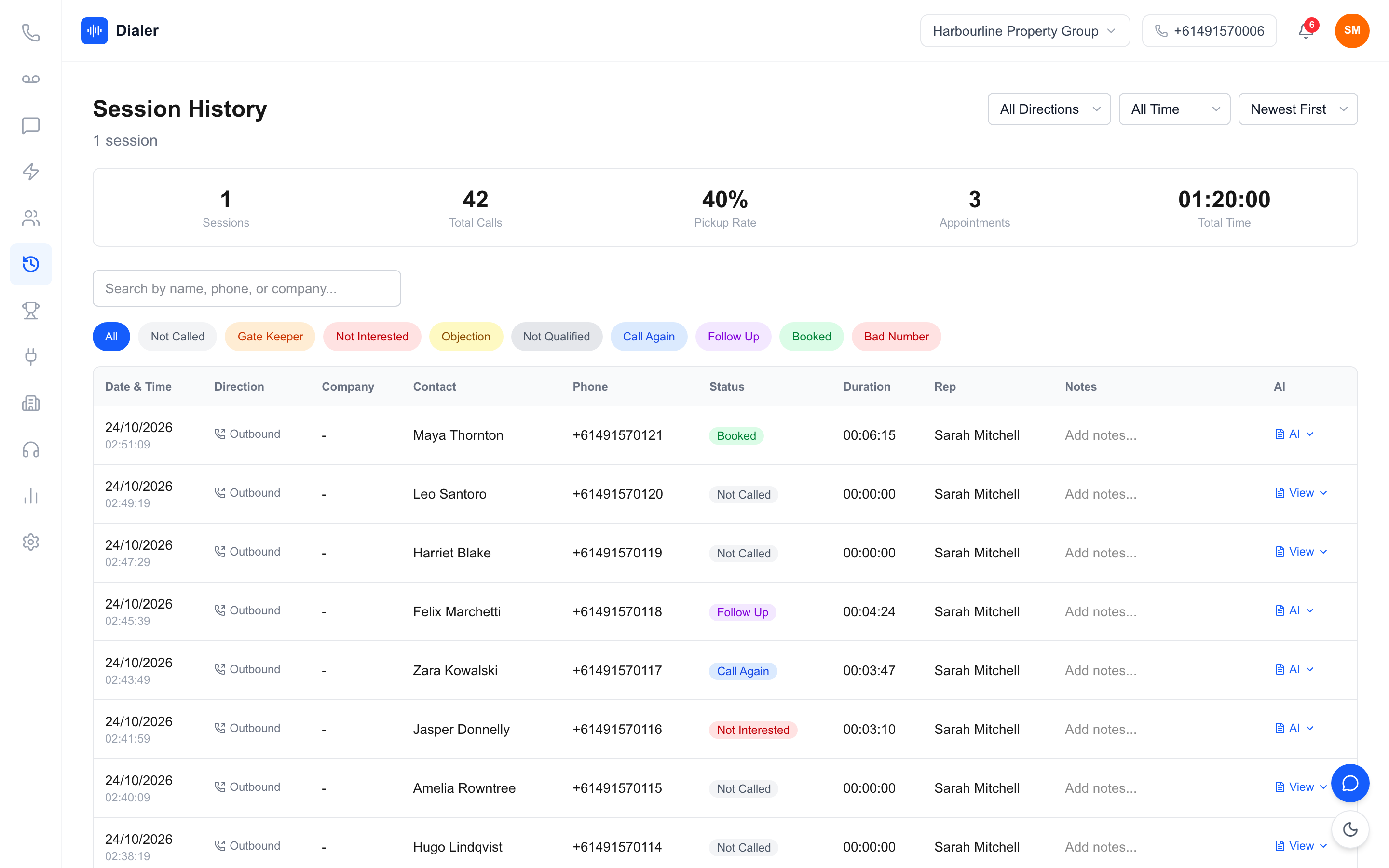
Because Veyce is a fully managed power dialer built for Australian teams, there is no separate transcription tool to buy, connect or reconcile: the numbers are provisioned and managed for you, calls are recorded in the dialler, and the AI summary is simply there when the call ends. Pricing is per organisation: Solo is $49/month, Team is $179/month for four seats, and you can see the full breakdown on the pricing page. Start with the free 3-day trial (counted from your first call, with 100 calling minutes and no credit card) to test the dialler, lead import, scripts and session flow on your own list; call recording with AI transcripts and summaries comes on the Team, Growth and Agency plans.
Beyond the summary: the 10X Call Breakdown
A summary tells a manager what happened. Veyce goes one step further for the rep: recorded calls made through your Veyce number also get a 10X Call Breakdown, a structured review of the call against a proven closing structure, from the opening line to the close. It appears in Session History after the call, next to the transcript and summary.
- A score out of 100 for how closely the call followed the structure.
- Why they said no, when the call did not close: the likely root cause in a sentence or two.
- The weak moments, quoted from the transcript, each with a line to say instead next time.
- A coach's note in plain, second-person language.
- Next-call actions for the follow-up.
It is not shown during the call, and it reviews the conversation rather than replacing a manager's judgement. Its value is that every rep gets specific, written feedback on their own words without waiting for a one-on-one.
The bottom line
AI call summaries do not replace call review; they make call review possible at the scale outbound teams actually operate at. The recording is the evidence, the transcript is the record, and the summary is the part a busy manager will genuinely read every day. If your team's call knowledge currently lives in unlistened recordings and memory, summaries are the cheapest operational upgrade you can make this quarter.
Frequently asked questions
Are AI call summaries accurate?
They are accurate enough for review, follow-up and pattern-spotting, with one rule: verify names, numbers and prices against the recording before using them in a quote or contract. Summaries generated from clear recordings are highly reliable on outcomes, objections and next steps.
Do AI call summaries work on every call?
In Veyce, on every call that is recorded and made through your Veyce number. Those calls are transcribed and summarised automatically after they end, with no separate transcription tool to connect, on the Team ($179 a month), Growth ($449) and Agency ($1,099) plans. Solo does not include call recording. Calls made from a rep's own phone outside Veyce, or with recording turned off, have no transcript.
What is the difference between a transcript and a summary?
A transcript is everything that was said, word for word, and it can run to thousands of words for a long call. A summary is the distilled version: outcome, key points, objections and agreed next steps, readable in under a minute. Teams read summaries day to day and open transcripts when they need exact wording.
Can summaries replace listening to calls?
No, and they should not try to. They tell you which calls deserve a listen. Managers typically read every summary and listen to a small number of full recordings: the wins, the near-misses and the calls a rep flags for help.