Australian solar sales calling software has a problem that overseas tools rarely think about: your homeowners live in three time zones, five sets of daylight saving rules and eight sets of public holidays. A team in Brisbane calling Perth at 8.30am local time is calling at 6.30am in Western Australia during summer. A team in Adelaide that forgets Queensland skips daylight saving will lose an hour of good evening calls every day from October to April.
This guide is for solar retailers and installers who sell by phone into more than one state. It covers how to plan calling blocks around local time, how to split lists and scripts by state, how to hand appointments to consultants in different regions, and what to look for in software that has to cope with all of it. For the general case for a power dialler on a solar floor, see our post on the power dialler for solar sales teams. This one is about geography.
Why geography matters for Australian solar sales calling software
Solar is one of the few consumer products sold by phone into every state at once. That makes the clock a sales variable.
Three time zones, and daylight saving on top
Mainland Australia runs on Australian Western Standard Time, Australian Central Standard Time and Australian Eastern Standard Time. From early October to early April, New South Wales, Victoria, the ACT, Tasmania and South Australia move forward an hour, while Queensland, the Northern Territory and Western Australia do not. In summer that means up to three hours between Sydney and Perth, and an hour between Adelaide and Darwin, which share a clock in winter. Any Australian solar sales calling software you use should know each lead's local time, not just your office's.
Calling hours follow the homeowner
Telemarketing calls in Australia are limited to set hours: on the register's industry standards page, weekdays from 9am to 8pm, Saturdays from 9am to 5pm, and no calls on Sundays or national public holidays. The practical lesson for a multi-state team is to plan around the hours where the homeowner is, not where your office is. A Sydney team starting at 9am cannot open with Perth leads, and the same team finishing at 7pm Sydney time still has an hour of Perth evening left.
Public holidays that do not line up
National public holidays are easy to plan for. State holidays are not. Labour Day falls on different dates in different states, Melbourne Cup Day is a Victorian holiday, and several states have their own show days or regional holidays. Even where calling is allowed, a public holiday changes who is home and what mood they are in. Keep a simple state holiday calendar beside your call plan.
Planning calling blocks around local time
A good multi-state call plan turns the clock from a problem into an advantage.
Follow the sun east to west
Start the morning on eastern leads, move to central leads as their morning settles, and finish the day on Western Australia. In summer, an east coast team can work Perth evening leads until well after its own 8pm, but only within Perth's calling hours. This keeps reps on productive lists for longer without anyone calling outside the hours.
Protect the evening window
Homeowners who decide on solar are often a couple, and many are only both home after work. The window from about 5pm to 8pm local time is precious. Build your rota so each state's evening window has reps on it, even if that means a later shift for one or two people.
Worked example: one floor, three zones
This is a worked example with assumptions, not a benchmark. Picture a Brisbane team in January. Brisbane is on AEST, Sydney and Melbourne are an hour ahead on AEDT, Adelaide is half an hour ahead on ACDT and Perth is two hours behind. A 9am to 5.30pm Brisbane shift could open at 9am Brisbane time on Queensland leads, since New South Wales and Victorian leads are already at 10am. After lunch it could move to South Australian leads, then switch to Perth leads from 3pm Brisbane time, which is 1pm in Perth. A second, later shift from 1pm to 9.30pm Brisbane time could cover the Sydney and Melbourne evening until 7pm Brisbane time, then Perth until 8pm Perth time, which is 10pm in Brisbane, so it would wind down at 9.30pm. Adjust this to your own leads and rosters.
Splitting lists, scripts and handoffs by state
Once the clock is handled, the next layer is making each conversation feel local.
One list per state or region
Keep separate lead lists by state, or by region inside large states. It makes calling blocks simple to run, it stops a rep accidentally starting on the wrong time zone, and it lets you compare answer and booking rates by region. If a list comes in mixed, split it on postcode before import.
Scripts that sound local
Incentives, network tariffs, typical roof types and even common objections differ between states. A script that mentions the wrong scheme or the wrong energy retailer loses trust fast. Keep a core script with short state sections, and avoid quoting rebate amounts on the phone unless your compliance team has signed them off for that state.
Handoffs to regional consultants
If your setters book in-home or video consultations with regional consultants, the handoff has to be clean: the right consultant for the postcode, the appointment in the homeowner's local time, and notes from the call. Book times in the homeowner's time zone and say the zone in your confirmation text, so nobody turns up an hour early in Adelaide.
Measure by region
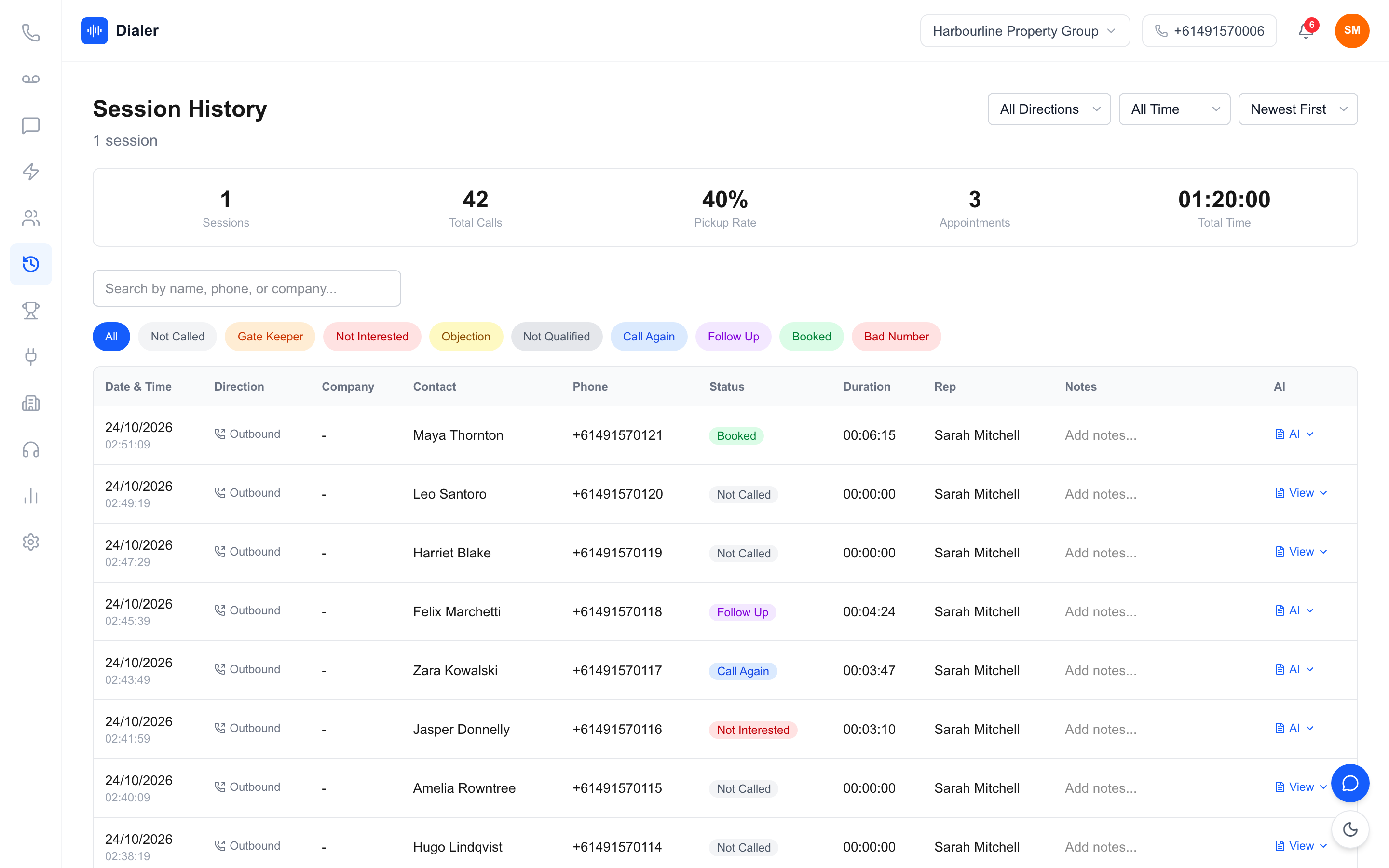
Track calls, conversations and booked appointments per state. A region with a high answer rate and a low booking rate is usually a script or offer problem. A region with a low answer rate is often a timing problem, so move its calling block before you change anything else.
What to look for in Australian solar sales calling software
Not every dialler copes with a national calling floor. Check these points before you commit.
Lead local time and calling hours
Any feature that dials automatically, especially one that rings several leads at once, should respect calling hours in the lead's local time and skip Sundays and national public holidays. Ask the vendor to show you exactly how it works out a lead's time zone.
An Australian number homeowners recognise
Calls and follow-up texts should come from the same Australian number, so a homeowner who missed your call recognises the text and the callback. Ask whether reps can have their own number, so callbacks reach the person the homeowner spoke to.
Lists, metrics and summaries for managers
Managers running a national floor need live session metrics, outcomes by list and summaries of recorded calls. Without them, regional problems stay hidden until the month's booking numbers arrive.
Veyce: Australian solar sales calling software for national floors
Veyce is an Australian power dialler with features that suit solar teams calling across states. You can read the overview on the Veyce page for solar sales teams.
Calling hours in the lead's local time
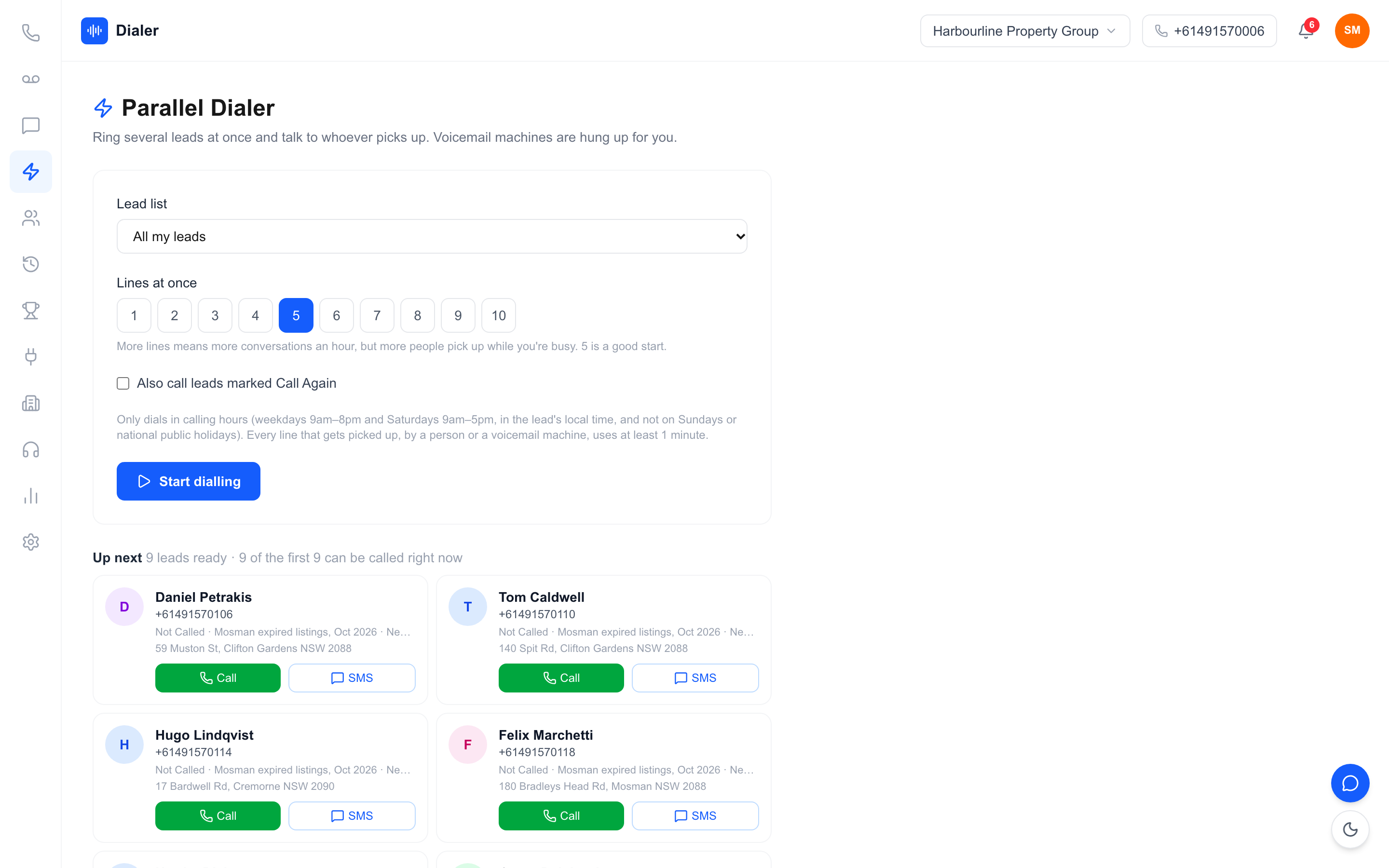
The Parallel Dialer add-on, available on Growth (up to 5 leads at once) and Agency (up to 10) for $99 a seat, only places calls weekdays 9am–8pm and Saturdays 9am–5pm, in the lead's local time, with no calls on Sundays or national public holidays. In Power Dialler mode, reps work one call at a time and the next lead loads when they are ready, so they can run state lists in the order your plan sets.
One number, texting and lists by state
Your team gets one dedicated Australian number included, and Veyce assigns a rep their own Australian number on request. Texts go out from the same number, with replies in the SMS inbox. Leads import from spreadsheets, PDFs and photos into separate lists, so a list per state takes minutes to set up. Veyce works with your wash: numbers the wash marks as registered are left out of PriceFinder imports, and the Delete DNCR Numbers button clears flagged leads.
Metrics and summaries managers actually read
Live session metrics, session history and a team leaderboard show how each calling block is going. Recorded calls are transcribed and summarised after the call, so a manager can check a region's conversations without listening to every recording. Plans are listed openly on the Veyce pricing page, from Team at $179 a month for four seats to Growth at $449 for ten.
Make the clock work for your team
Australian solar sales calling software earns its place on a national floor when it treats each lead's local time as seriously as you do. Plan calling blocks east to west, protect every state's evening window, keep lists and scripts by state, hand off appointments in the homeowner's time zone, and measure each region separately.
If you want to try that with your own leads, start a free trial of Veyce: 3 days from your first call and 100 calling minutes, no card required, with your Australian number included.
Frequently asked questions
What hours can solar companies make telemarketing calls in Australia?
The Do Not Call Register's industry standards page lists telemarketing hours as 9am to 8pm on weekdays and 9am to 5pm on Saturdays, with no calls on Sundays or national public holidays. For a team calling into several states, plan around the homeowner's local time rather than your office clock. Read the standard on donotcall.gov.au and get your own advice if you are unsure how it applies to your campaigns.
How do I handle daylight saving when calling across Australia?
From early October to early April, New South Wales, Victoria, the ACT, Tasmania and South Australia move forward an hour, while Queensland, the Northern Territory and Western Australia do not. That creates up to three hours between Sydney and Perth. The simplest fix is to keep a lead list per state and run each list in a calling block that suits that state's local time, east to west through the day.
Should solar setters use different scripts for different states?
Usually, yes. Keep a core script for the opening, qualification and booking, then add short state sections. Incentives, network tariffs, energy retailers and common objections vary by state, and a homeowner notices quickly when a caller gets a local detail wrong. Avoid quoting rebate figures on the phone unless your compliance team has approved the wording for that state and it is current.
Does Veyce's Parallel Dialer respect local calling hours?
Yes. The Parallel Dialer add-on only places calls weekdays 9am–8pm and Saturdays 9am–5pm, in the lead's local time, and makes no calls on Sundays or national public holidays. It is available on the Growth plan, ringing up to 5 leads at once, and on Agency, up to 10, for $99 a seat a month. In Power Dialler mode, reps work one call at a time and choose which list to run.
Can a solar team trial Veyce before committing?
Yes. The free trial runs for 3 days from your first call, with 100 calling minutes, and needs no card. Each trial call ends after 7 minutes. Your Australian number is included. The best test for a multi-state team is to import one washed list for two different states, run a calling block for each at the right local time, and compare answer rates and bookings in the session history before choosing a plan.