The best time to cold call in Australia is not one magic hour. It is the overlap of three things: the hours you are allowed to make telemarketing calls, the local time where the person you are ringing lives, and the moments when your kind of buyer actually picks up. Get the first two wrong and you create complaints. Get the third wrong and you burn a good list for nothing.
This guide walks through all three. It covers the calling hours every team should plan around, how to run a national list across five summer time zones, the windows worth testing for business and household calls, and a simple four-week method for finding your own peak from your own numbers. It is general information, not legal advice.
The hours you can call before you pick the best time to cold call in Australia
Telemarketing calling hours in plain terms
Start with the outer limits. The Do Not Call Register's industry standards page summarises telemarketing calling hours as weekdays 9am to 8pm and Saturdays 9am to 5pm, with no calls on Sundays or national public holidays unless the person has agreed to a call at that time. The detail sits in the Telemarketing and Research Calls Industry Standard 2017. Research calls have different hours, so do not borrow a market researcher's timetable for a sales campaign.
The clock that counts is the lead's
Those hours are measured where the person receiving the call is, not where your rep is sitting. A Sydney rep who starts a Perth list at 9am Sydney time in January is ringing people at 6am. A Perth rep who works until 6pm in summer is ringing Sydney at 9pm. Both are outside the hours above, and both are easy mistakes on a national list sorted by anything other than state.
Public holidays and agreed times
National public holidays are out. State holidays are worth treating the same way, because nobody thanks you for a sales call on Melbourne Cup Day or a show day. The one flexible point is consent: if a person asks you to ring at 7:30am before their shift, that is their choice, and you should record who agreed, when, and what time they asked for. Our ACMA telemarketing compliance guide explains the rulebooks behind these points in more depth.
Time zones: one national list, five clocks
Summer and winter offsets
From early April to early October, Australia has three clocks: the eastern states, South Australia and the Northern Territory half an hour behind, and Western Australia two hours behind. From early October to early April, daylight saving splits them into five, because New South Wales, Victoria, Tasmania, the ACT and South Australia move forward and Queensland, the Northern Territory and Western Australia do not.
In summer, when it is 12 noon in Sydney and Melbourne, it is:
- 11:30am in Adelaide
- 11am in Brisbane
- 10:30am in Darwin
- 9am in Perth
Build call blocks by state
The practical fix is to stop thinking of one list and start thinking in state blocks. An east coast team in summer might work New South Wales, Victoria and Tasmania first thing, add Queensland and South Australia mid-morning, and leave Western Australia for after lunch. A Perth team does the reverse: east coast first, because that window closes soonest, and local calls late in the day.
Add a state or time zone column to every list before it goes near a dialler. If your data only has postcodes, the first digit gets you most of the way: 2 for New South Wales and the ACT, 3 for Victoria, 4 for Queensland, 5 for South Australia, 6 for Western Australia, 7 for Tasmania and 0 for the Northern Territory.
Mobile numbers hide where people live
A landline area code tells you the state. A mobile number tells you nothing, and most lists are now mostly mobiles. If you have no address for a mobile lead, the safe working window is the one that is inside calling hours everywhere at once. In summer that is roughly midday to 8pm Sydney time on weekdays, which is 9am to 5pm in Perth. It is narrower than you would like, which is a good reason to collect a suburb or postcode at the point the lead is created.
Windows worth testing for the best time to cold call in Australia
Calling businesses
For business calls, test around the shape of the working day and not around folklore. Decision makers are often reachable before their meetings begin, in the gap before lunch, and late in the afternoon when the diary thins out. Monday mornings and Friday afternoons tend to be poor for long conversations but fine for quick callbacks. Trades and site-based businesses are different again: the owner is on the tools mid-morning and more likely to answer early, at smoko or after 3pm.
Calling households
For household calls, such as solar, real estate and home services, the pattern follows who is home. Weekday daytime reaches retirees, shift workers and people working from home. Late afternoon and early evening reach working households, and the weekday limit of 8pm leaves a useful window after dinner prep begins. Saturday morning is often the strongest slot of the week for homeowners, and it closes at 5pm.
Why your own data beats any benchmark
Every published "best hour" comes from someone else's list, industry and country. Your answer depends on your list source, your offer and your region. Treat the windows above as hypotheses to test, not conclusions. A team calling farm businesses in regional Queensland and a team calling apartment owners in inner Melbourne will find different peaks, and both will be right.
Veyce: seeing when your own calls connect
Session numbers and outcomes
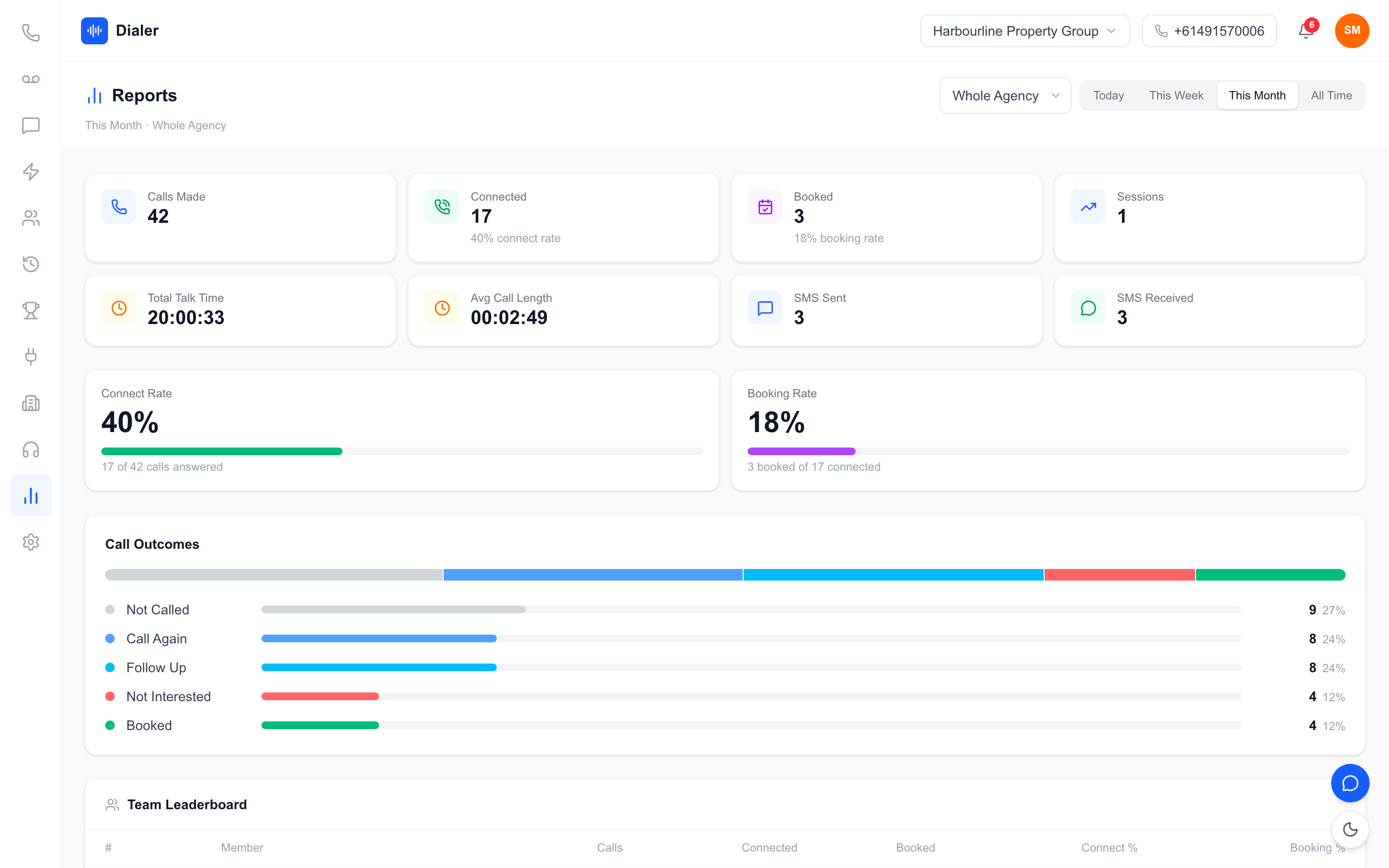
Veyce is a power dialler for Australian sales teams. In Power Dialler mode it rings one lead at a time, the rep marks an outcome on every call, and live session metrics show calls and outcomes as the session runs. Because every session is kept in session history, you can compare a 9am block with a 4pm block on the same list and see which one produced more conversations per hour, without building a spreadsheet first.
What the Parallel Dialer does with the clock
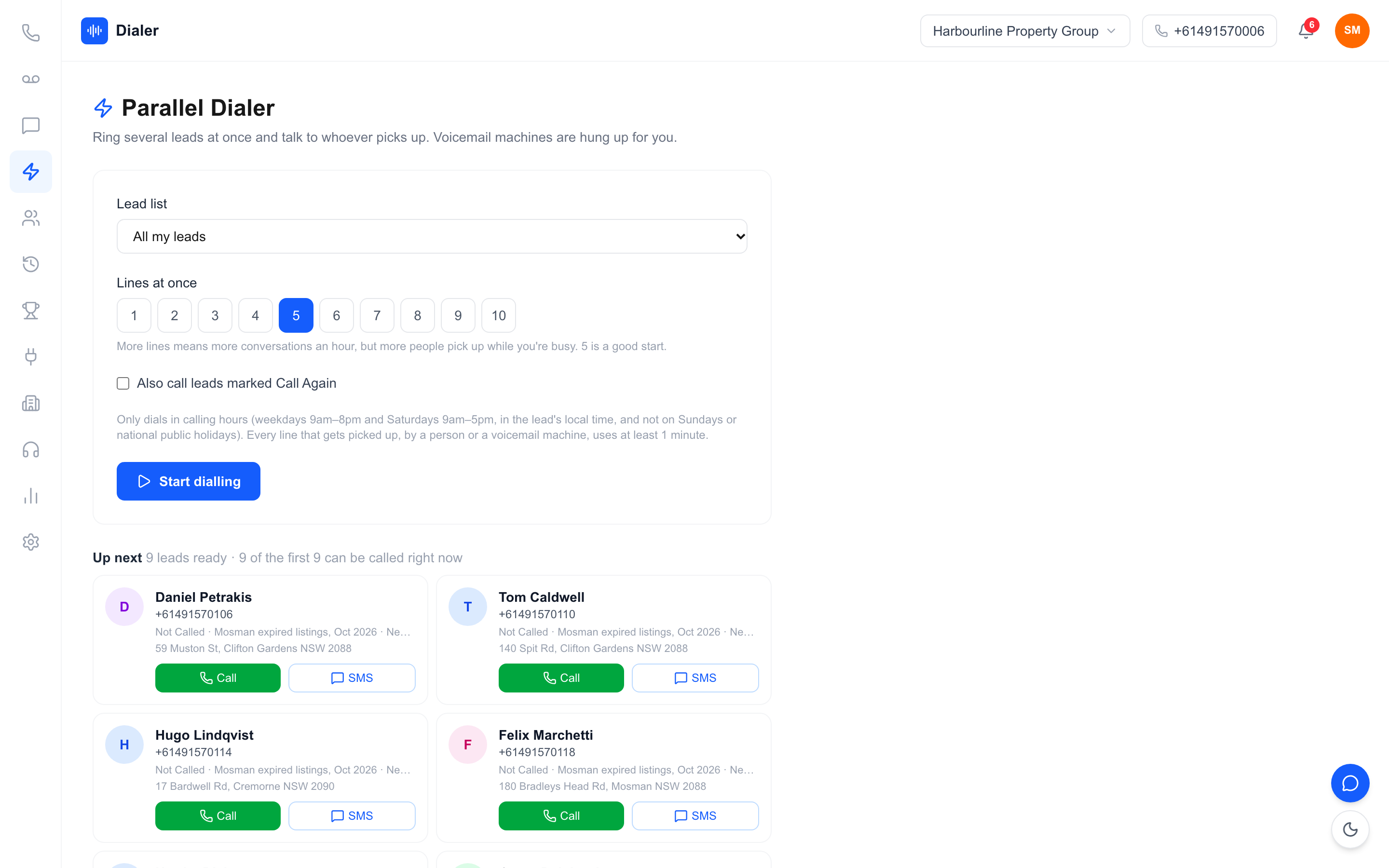
The optional Parallel Dialer add-on, on Growth and Agency at +$99 a seat, rings up to 5 leads at once on Growth and up to 10 on Agency. It places calls weekdays 9am–8pm and Saturdays 9am–5pm, in the lead's local time, and it does not place calls on Sundays or public holidays, national or the lead's state's. That is a description of how the add-on behaves. Your own obligations still need your own checks, including a Do Not Call Register wash: Veyce does not wash numbers itself, it works with the wash you run.
Plans and the free trial
Session metrics, session history and leaderboards are part of every plan: Solo at $49 a month (1 seat, 100 minutes), Team at $179 (4 seats, 400 minutes), Growth at $449 (10 seats, 1,000 minutes) and Agency at $1,099 (25 seats, 2,500 minutes). The free trial runs for 3 days from your first call with 100 calling minutes and no card, which is enough to run a morning block and an afternoon block on a real list. The plans and pricing page has the full breakdown.
Conclusion: find your own best time in four weeks
A simple timing test
You do not need statistics software. You need consistent blocks and honest outcomes.
- Split the calling day into four blocks: 9am to 11am, 11am to 1pm, 2pm to 4pm and 4pm to 6pm, in the lead's local time. Add an evening or Saturday block if you call households.
- Rotate one list through all four. Do not give the morning block your freshest leads and the afternoon block the leftovers, or you will measure the list and not the time.
- Count conversations and bookings per calling hour for each block. Dials tell you about effort. Conversations tell you about timing.
- After four weeks, move the hardest prospecting into the two strongest blocks and use the weakest for callbacks, admin and list preparation.
Your next step
Run the test again whenever your list source changes or daylight saving starts or ends, because the best time to cold call in Australia shifts with both. If you want the counting done for you while reps dial, Veyce is a power dialler built for Australian sales teams with session metrics on every plan. Start a free trial and compare your first two blocks this week.
Frequently asked questions
What is the best time to cold call in Australia?
There is no single best hour for every team. Start inside telemarketing calling hours in the lead's local time, then test blocks. Many business teams find late morning and late afternoon productive, and many household teams do well in the early evening and on Saturday mornings. Run each block on the same list for four weeks and keep the two that produce the most conversations per calling hour.
What hours can you make telemarketing calls in Australia?
The Do Not Call Register's industry standards page summarises telemarketing calling hours as weekdays 9am to 8pm and Saturdays 9am to 5pm, with no calls on Sundays or national public holidays unless the person has agreed to a call at that time. The hours apply in the local time of the person being called. Check the Telemarketing and Research Calls Industry Standard 2017 on legislation.gov.au for the detail. This is general information, not legal advice.
How do time zones affect cold calling across Australia?
Calling hours are measured where the lead is. In winter there are three clocks, with South Australia and the Northern Territory half an hour behind the east coast and Western Australia two hours behind. In summer, daylight saving creates five, and Perth sits three hours behind Sydney. Sort lists by state, call the east coast first from the west, and leave Western Australia until after lunch from the east.
Is it better to cold call in the morning or the afternoon?
It depends on who you call. Office-based decision makers are often reachable before meetings start and again late in the day. Trades answer early or after 3pm. Working households answer in the late afternoon and early evening. The only reliable answer comes from your own outcomes, so compare conversations and bookings per calling hour for a morning block and an afternoon block on the same list.
Does Veyce stop calls outside calling hours?
The optional Parallel Dialer add-on on Growth and Agency only places calls on weekdays 9am to 8pm and Saturdays 9am to 5pm, in the lead's local time, and not on Sundays or public holidays. In Power Dialler mode the rep chooses when to run a session, so planning state blocks is still the team's job. Veyce describes how its tools behave; your obligations need your own checks.