Buying B2B cold calling software? Australia has its own rules, time zones and business buyers, so the tool has a different job from the consumer diallers built for high-volume household campaigns. When you sell to businesses, you call during working hours, reach a receptionist before a decision maker, and need three to six touches before a meeting lands. The software has to keep track of companies, people and conversations across weeks, not just push through a list as fast as possible.
This guide is for Australian teams selling services, software, equipment or supply contracts to other businesses: agencies, IT providers, commercial cleaners, freight and logistics firms, recruiters and the like. It covers how B2B calling differs, the features that matter, how to compare options fairly using published pricing, and where Veyce fits. Nothing here relies on industry averages; where numbers appear, they are worked examples with the assumptions stated.
How B2B cold calling differs in Australia
The mechanics of dialling are the same, but almost everything around the call changes when the person you want is at work.
You are calling a business, not a household
The time zone point alone rules out some B2B cold calling software. Australia spans three main time zones, and your calling window is the prospect's working day, which in practice means mid-morning and mid-afternoon in the prospect's own state. A team in Sydney calling Perth businesses at 9am Sydney time is calling at 6am Perth time, so your lists need the state or time zone, and your sessions need to follow the sun. Rules still apply to business calls: telemarketing calls are covered by an industry standard, and you should not assume a number is exempt from the Do Not Call Register just because it belongs to a business. The Do Not Call Register industry FAQs explain what is covered.
Gatekeepers and switchboards
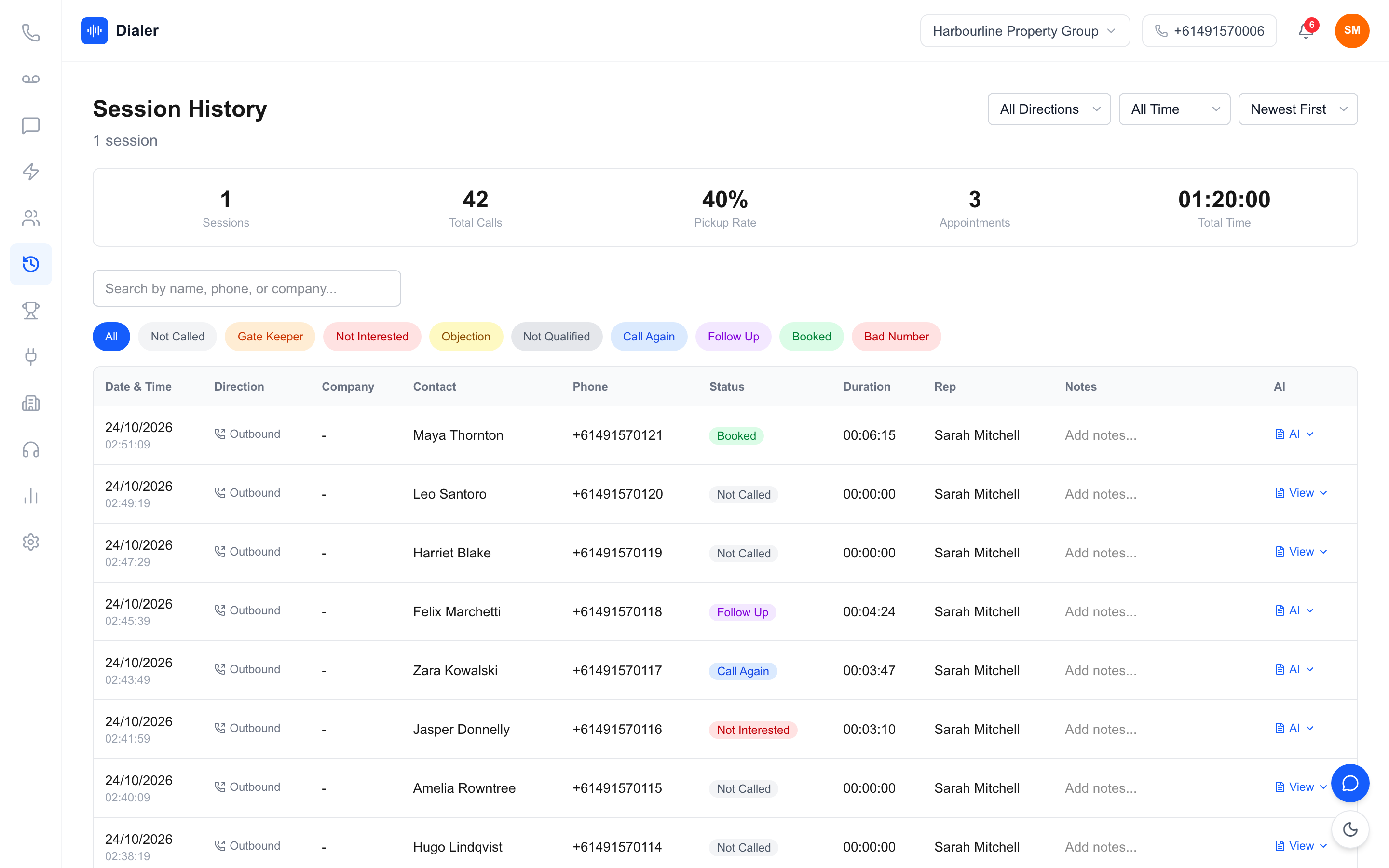
Many B2B calls start with a receptionist or a main line. Good B2B calling records what the gatekeeper told you (the decision maker's name, the best time, the right extension) so the next attempt is warmer. Software that only records "no answer" or "not interested" throws that information away.
Longer cycles, more touches
A business buyer rarely agrees to anything on the first call. The work is in the follow-up: a callback at the time they named, an email with the one-page summary, a short text confirming the meeting. Software that makes the second and third touch easy matters more than raw dial speed.
Features that matter in B2B cold calling software
Use these as your shortlist criteria for B2B cold calling software. Australia-based teams will recognise each one from their own calls, because they are drawn from the B2B workflow above, not from vendor feature pages.
Company-level lead records and notes
Each lead should carry the company name, the contact's role and a running note of every conversation, so whoever calls next sees what happened. Merge fields such as the company name also make follow-up texts and emails read as personal rather than generic.
Outcomes that match a B2B pipeline
Standard outcome buttons rarely fit B2B. You want labels like "gatekeeper, call back", "decision maker reached", "meeting booked" and "not now, revisit next quarter". Check that the outcome list can be renamed and reordered to match your stages, and that you can filter a list by outcome to run a session on just the callbacks.
Recording and summaries for handovers
In many B2B teams, the person who books the meeting is not the person who runs it. A recording and a written summary of the booking call let the account manager walk in knowing what was said, without a long handover note. Our post on AI call summaries for sales teams covers how teams use them.
CRM sync and lead import
B2B lists come from many places: a data provider's CSV, a LinkedIn research spreadsheet, a trade show scan, the CRM. Import should handle the common formats and map fields predictably, and if you run a CRM, outcomes should flow back without retyping.
Comparing B2B cold calling software: Australia options and pricing
Most options fall into two groups: full cloud phone systems with a dialler attached, and focused outbound diallers. Neither is better in general; they suit different teams.
Full phone systems versus focused diallers
A cloud phone system handles inbound routing, IVR menus and support queues as well as outbound calls, which suits a company that wants one phone platform for everyone. A focused dialler concentrates on the outbound workflow: lists, scripts, power dialling, outcomes and follow-up. If your callers spend most of the day making outbound calls, the focused tool usually has fewer clicks between conversations. Our guide on how to choose a power dialler in Australia lists nine checks for either type.
What published pricing shows
From each vendor's public pricing page, checked 22 October 2026: Aircall's power dialler is on the Professional plan and above at A$75 per licence per month billed annually, with a 3-licence minimum. JustCall's power dialler is on Pro and above at US$49 per user per month billed annually, with a 2-user minimum. Kixie lists PowerDialer plans but does not publish prices. Prices and plans change, so confirm with each vendor, and see the side-by-side pages for Veyce compared with Aircall and Veyce compared with JustCall.
A worked example: pricing a five-rep team
This is an illustration using published list prices, not a quote. Assume five reps on monthly plans. Veyce Team covers four seats for $179 a month, and a fifth seat is $29, so $208 a month with 400 shared minutes. Aircall Professional at the annual rate would be 5 x A$75 = A$375 a month, with 1,000 domestic outbound minutes included per its pricing page. JustCall Pro at the annual rate would be 5 x US$49 = US$245 a month before currency conversion. Included minutes, numbers and billing terms differ, so price your actual calling volume, not just seats, and ask each vendor whether its minutes cover calls to Australian mobiles as well as landlines.
Veyce: B2B cold calling software for Australian teams
Veyce is a power dialler for Australian sales teams, with the phone side included, built around the outbound workflow rather than a full phone system.
Lists, scripts and outcomes
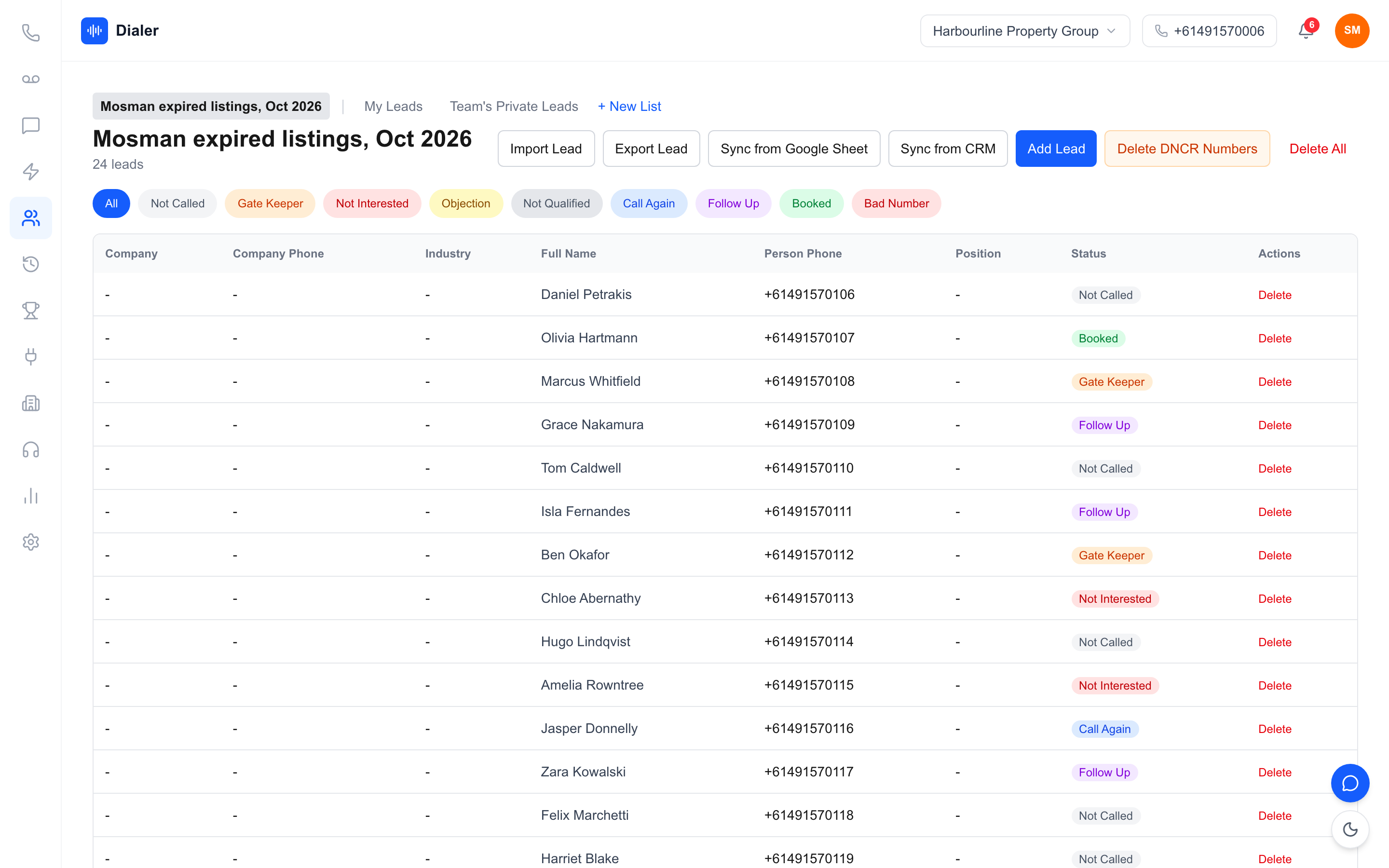
Import leads from CSV files and spreadsheets, or from PDFs and photos using OCR with rule-based field mapping, or from Google Sheets. The team script sits beside every call, typed in or synced from a Google Doc, and outcome labels can be renamed and reordered in Settings to match your B2B stages. In Power Dialler mode, Veyce calls one lead at a time and moves on as soon as the rep logs the outcome.
Numbers, texts and recordings
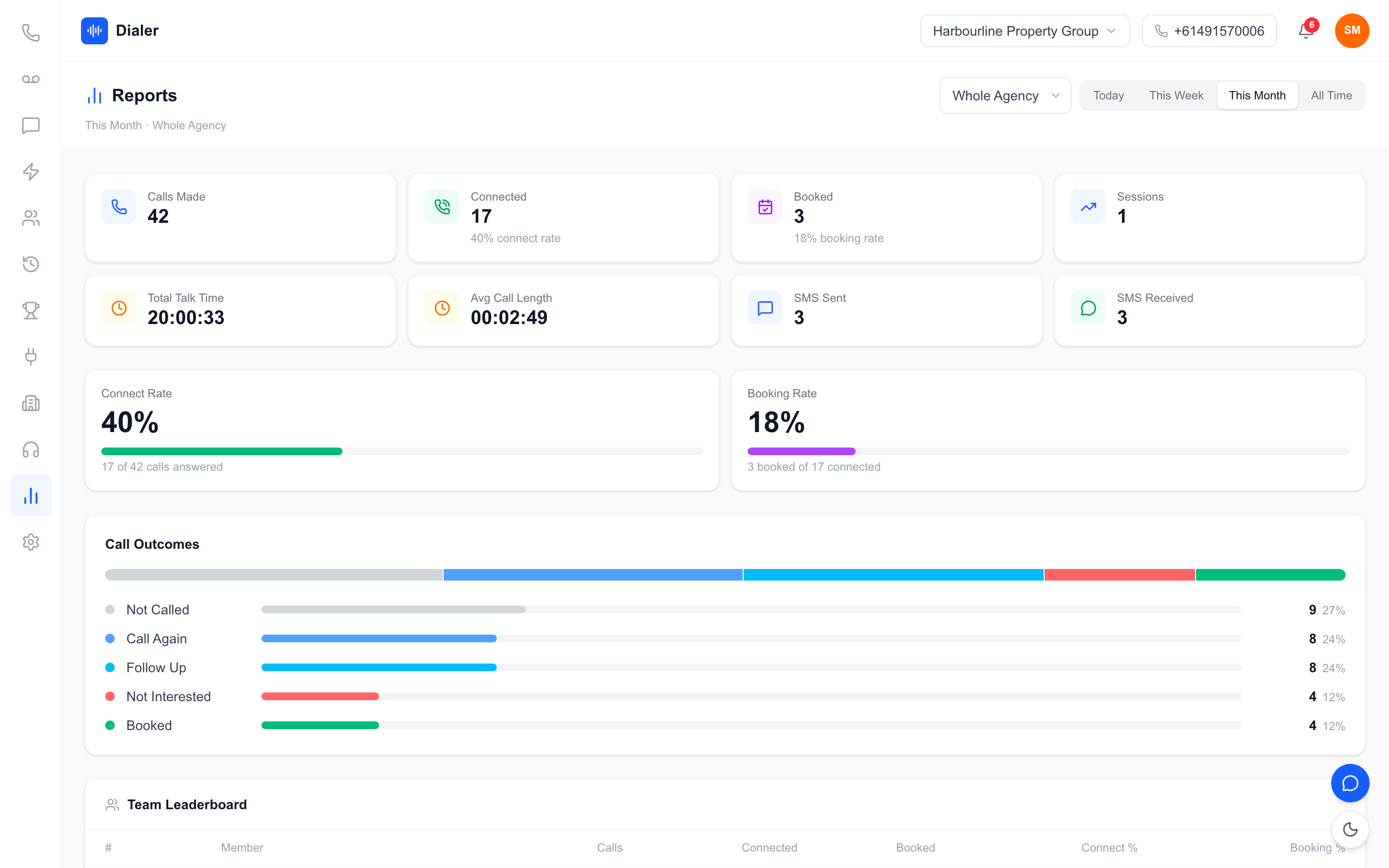
Your team gets one dedicated Australian number included, and Veyce assigns a rep their own Australian number on request, so callbacks ring that rep first, then the team, then voicemail. Texts go out from the team number, or from the rep's own number if assigned, and replies land in the Messages inbox. Recorded calls get an AI transcript and summary after the call, which makes the handover from caller to account manager quick.
Plans and trial
Solo is $49 a month (1 seat, 100 minutes), Team $179 (4 seats, 400 minutes), Growth $449 (10 seats, 1,000 minutes) and Agency $1,099 (25 seats, 2,500 minutes), with extra seats at $29. All prices are on Veyce's pricing page, and the trial runs for 3 days from your first call, with 100 calling minutes and no card.
Pick the tool that fits your sales cycle
The right choice of B2B cold calling software, Australia-wide, is the one that remembers what the gatekeeper said, makes the third touch as easy as the first, and hands a booked meeting over cleanly. Dial speed matters, but in B2B it is rarely the bottleneck.
Shortlist two or three tools against the features above, price your real team and calling volume, and run each on the same list for a week. If you want Veyce in that comparison, start a free 3-day trial, counted from your first call, with 100 calling minutes, or read the Australian power dialler overview first.
Frequently asked questions
What is B2B cold calling software?
It is software that helps a team make outbound calls to businesses and manage the follow-up. Beyond dialling, a good tool keeps company and contact details together, records what each call produced with outcome labels that fit a B2B pipeline, shows the script during calls, records and summarises conversations, and makes callbacks, texts and emails easy. The aim is to carry context across the several touches a business sale usually needs.
Do Do Not Call Register rules apply to calls to businesses?
Do not assume they do not. The register and the telemarketing industry standard set out which numbers and calls are covered, and the answer depends on the details, so read the Do Not Call Register industry FAQs on donotcall.gov.au before you start calling. Veyce does not wash numbers; it works with your wash: numbers the wash marks as registered are left out of PriceFinder imports, and the Delete DNCR Numbers button clears flagged leads.
When is the best time to cold call businesses in Australia?
There is no universal best time, so test it with your own lists. Many teams find mid-morning and mid-afternoon on weekdays work, avoiding Monday morning and the end of Friday, but this varies by industry and role. Always work in the prospect's local time: Western Australia is two or three hours behind the east coast depending on daylight saving, and Queensland does not observe daylight saving.
Is a power dialler suitable for B2B calling?
Yes. A power dialler calls the next lead only when the rep is ready, so every answered call reaches a person who is prepared, which suits B2B, where conversations are fewer and matter more. Predictive diallers, which ring several numbers per rep, are built for high-volume consumer campaigns. Veyce is a power dialler rather than a predictive one, with an optional Parallel Dialer add-on on Growth and Agency plans.
How much does B2B cold calling software cost in Australia?
It depends on the vendor, the plan and how many reps you have. Published prices checked in October 2026 range from per-user plans in US dollars to per-licence plans in Australian dollars with minimum licence counts. Veyce starts at $49 a month for one seat with 100 minutes, and Team is $179 a month for four seats with 400 minutes. Always price your real team size and calling volume.