Working out how to improve cold call conversion rates starts with admitting that "conversion" hides four different numbers. A team can lift bookings by fixing its list, its timing, its opener or its close, and each fix works on a different stage. Teams that try to fix everything at once, usually with a new script, often change nothing because the real leak was somewhere else.
This guide to how to improve cold call conversion rates treats cold calling as a funnel you can measure. It shows how to split your results into stages, find the stage that is leaking, fix it with one change at a time, and check whether the change worked. The figures in the worked examples are illustrative, with their assumptions stated, because every team's market and list are different. For general technique on openers and objections, see our cold calling tips for Australian sales teams; this post is about measurement and diagnosis.
Break cold call conversion into stages you can measure
The four ratios that matter
Instead of one conversion rate, track four:
- Connect rate: answered calls divided by dials.
- Conversation rate: conversations that last past the opener (say, 30 seconds) divided by answered calls.
- Meeting rate: booked meetings or appointments divided by conversations.
- Show or close rate: meetings that happen, or deals that close, divided by meetings booked.
Multiply the four and you get bookings per dial. Change any one and the whole chain moves.
A worked baseline
Worked example, with assumptions stated: a rep makes 600 dials a week. Assume a 12% connect rate, 50% of answers become real conversations, 10% of conversations book a meeting, and 70% of meetings happen. That is 72 answers, 36 conversations, about 3.6 meetings booked and about 2.5 meetings held. These numbers are not benchmarks; they are a template for plugging in your own.
Why stage data beats gut feel
In that example, lifting the meeting rate from 10% to 13% adds about one booking a week, the same as lifting the connect rate from 12% to about 15.6%. Which is easier depends on where your team is weakest, and only stage data tells you. Most diallers and CRMs can give you dials, answers and outcomes; the conversation threshold may need a call-length filter.
Set up tracking in one week
You do not need new software to start. For one week, ask every rep to log an outcome on every dial: no answer, wrong number, answered but ended early, conversation, callback booked, meeting booked. Agree the definitions first, so one rep's "conversation" is not another's "hung up". At the end of the week, work out the four ratios per rep and for the team. That baseline is the starting point for every decision about how to improve cold call conversion rates on your team, and it usually surfaces at least one surprise, such as a rep with a strong meeting rate but a low connect rate who simply calls at the wrong times.
Fix the top of the funnel: connect rate
List quality first
Wrong numbers, disconnected lines and stale data drag down connect rate before a rep says a word. Clean your lists, remove duplicates and record where each list came from. For consumer numbers, wash against the Do Not Call Register: the register's industry FAQs say a wash in the 30 days before a call, where the register did not show the number as registered, means you will not be in breach. Our DNCR compliance guide covers the full process. This is general information, not legal advice.
Timing within the permitted hours
Testing different call times is one of the cheapest ways to lift connects. Stay inside the permitted hours: the register's industry standards page summarises telemarketing calling hours as weekdays 9am to 8pm and Saturdays 9am to 5pm, with no calls on Sundays or national public holidays unless the consumer has agreed, under the Telemarketing and Research Calls Industry Standard 2017. Within that window, split your sessions into blocks and compare connect rates by block over a few weeks.
A local number people recognise
People are more likely to answer a number that looks local and that they can call back. Use a consistent Australian number rather than a rotating set of unknown numbers, and make sure callbacks reach someone. A lead who calls back and gets nobody is a connect you paid for and lost. Start a free 7-day Veyce trial with 50 calling minutes included.
Fix the middle: from answer to meeting
The opener decides the conversation rate
If plenty of people answer but few stay past 30 seconds, the opener is the problem. Test one change at a time: say the reason for the call in the first sentence, name a relevant local detail, or ask a short permission question. Run each version for a set number of conversations before judging it.
Listen to calls, not just numbers
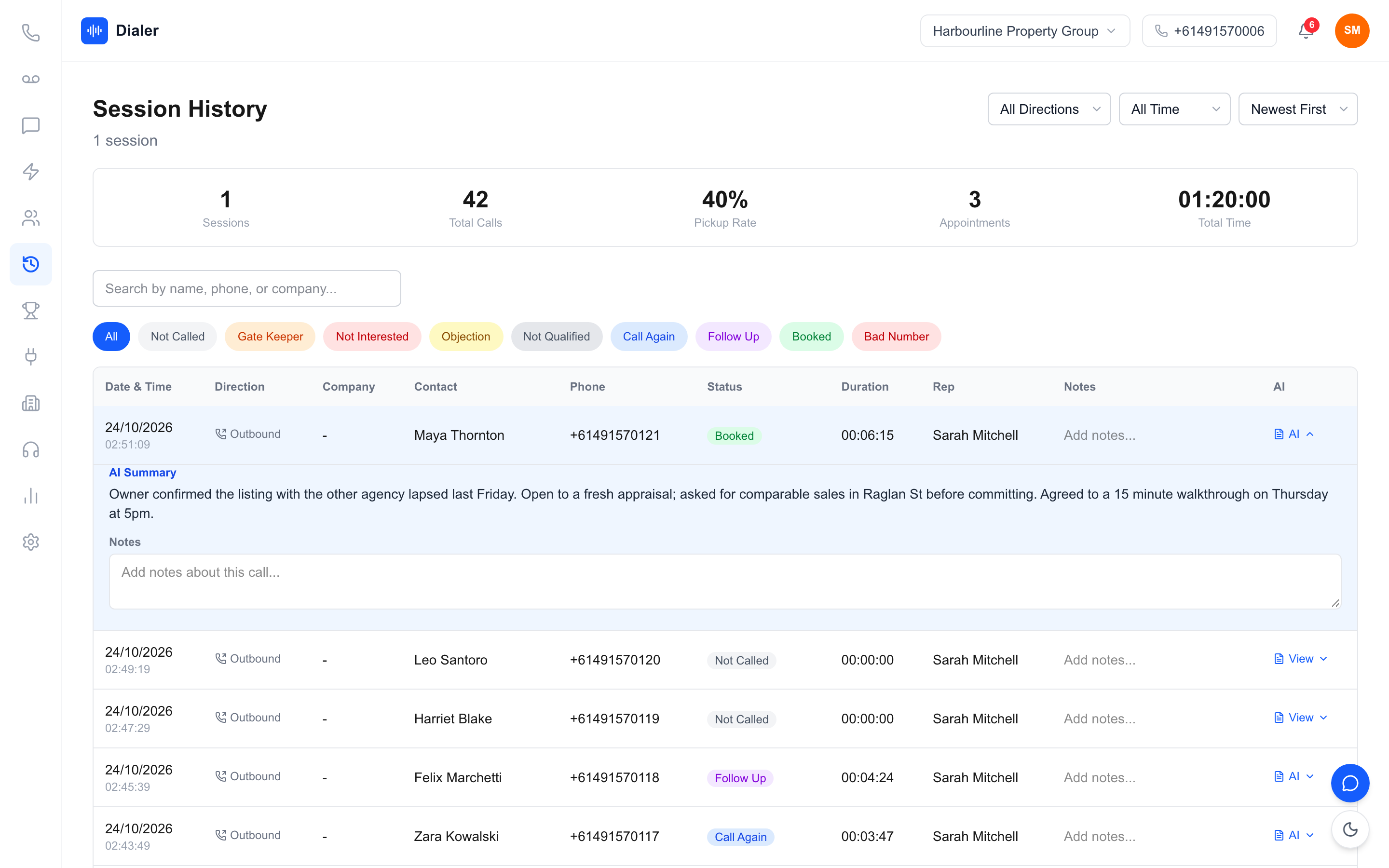
Stage data shows where the leak is; recordings show why. Pick five lost conversations a week per rep and listen for the moment the lead disengaged. Summaries make this faster: read what happened, then play only the part that matters.
A clear, small ask
Meeting rate often improves when the ask gets smaller and more specific: a 15-minute call on Thursday at 10am, not "a chat sometime". Offer two times, confirm by text if the lead agrees to receive one, and log the booking straight away.
Fix the bottom: shows and follow-up
Confirm and remind
A booked meeting that does not happen is a conversion lost at the last step. Confirm the time on the call, send a confirmation if the lead agreed to a text, and remind them the day before. Follow-up texts are commercial messages, so follow ACMA's spam rules: consent, clear sender details and an easy unsubscribe.
Work the callbacks
"Call me next week" is a lead, not a no. Log callbacks with a date and a note, and work them before new leads in each session. Many teams find more bookings in callbacks than in fresh dials; measure it for your own team.
Review weekly, change one thing
Once a week, look at the four ratios per rep and for the team. Pick the weakest stage, agree one change, and measure it next week. Leaderboards help when they show the right metric: conversations and meetings, not just dials.
Avoid the common measurement traps
Three traps undo most efforts to improve cold call conversion rates. The first is changing the script, the list and the call times in the same week, so nobody knows which change worked. The second is judging a change on a handful of calls; give each test enough conversations to mean something before you keep or drop it. The third is rewarding dials alone, which pushes reps to rush conversations and lowers the meeting rate you are trying to lift.
Veyce: measuring and improving conversion
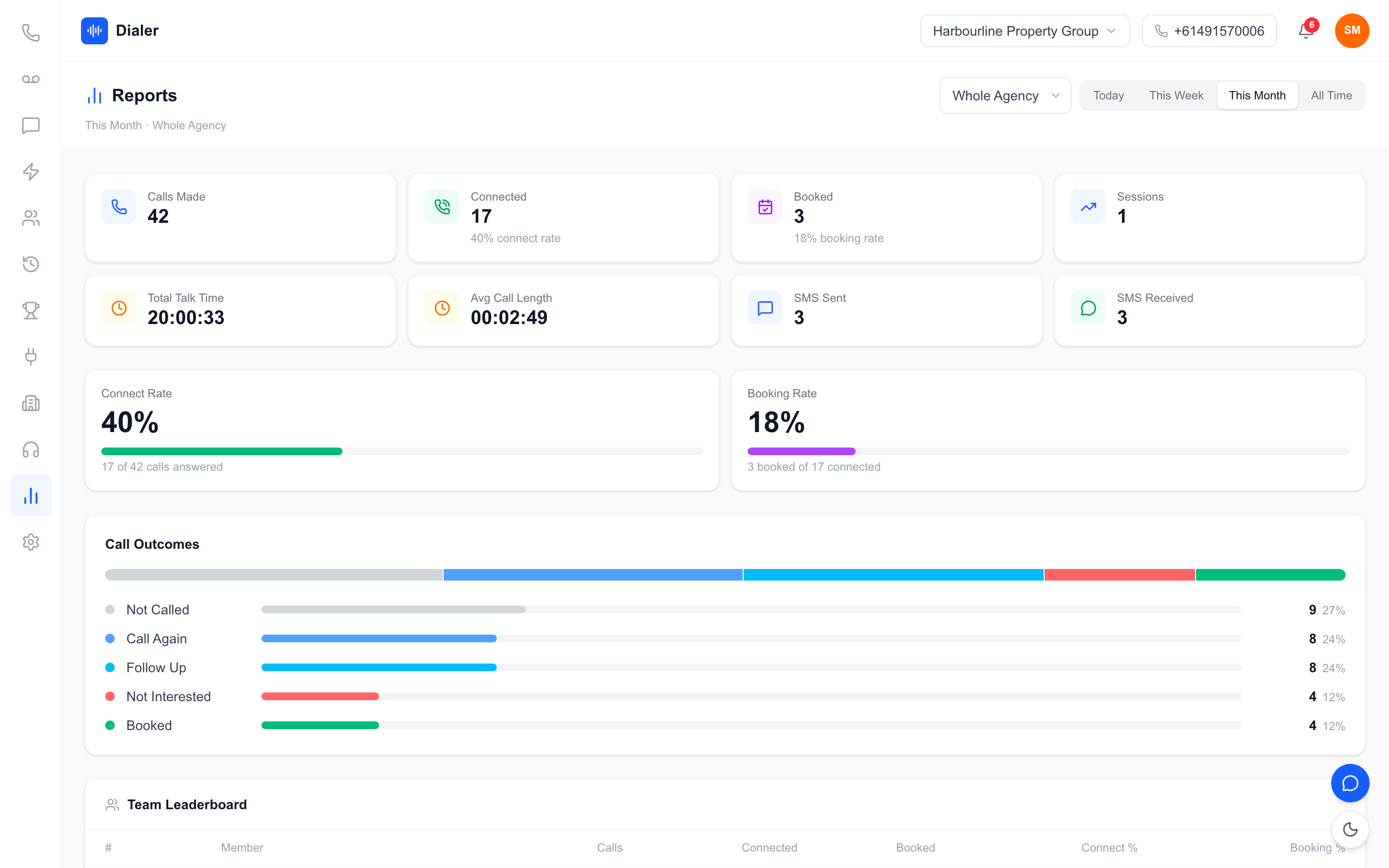
Live metrics and leaderboards
Veyce shows live session metrics and leaderboards, so a manager can follow each rep's calling and outcomes while a session runs. That gives you the stage data in this guide without building spreadsheets. In Power Dialler mode, Veyce rings one lead at a time, so every answered call goes straight to a rep.
Summaries, scripts and texts
Recorded calls get an AI transcription and summary after the call, which speeds up the weekly listening review. Calling scripts sync from Google Docs, so a tested opener reaches every rep at once. Texts go out from your team's dedicated Australian number through the SMS inbox, and Veyce assigns a rep their own Australian number on request.
More connects per hour
On Growth and Agency, the optional Parallel Dialer add-on (+$99 a seat) rings up to 5 leads at once on Growth and up to 10 on Agency. It only places calls weekdays 9am–8pm and Saturdays 9am–5pm, in the lead's local time, and not on Sundays or national public holidays. Veyce works with your wash: numbers the wash marks as registered are left out of PriceFinder imports, and the Delete DNCR Numbers button clears flagged leads. See the full product on the Veyce power dialler page.
Conclusion: how to improve cold call conversion rates, one stage at a time
The reliable answer to how to improve cold call conversion rates is to stop treating conversion as one number. Measure connect, conversation, meeting and show rates; fix the weakest stage with one change; and check the result a week later. Small gains at two stages compound into a noticeable lift in bookings per dial. To see your own stage data in a live session, compare Veyce plans and pricing or start a free 3-day trial, counted from your first call, with 100 calling minutes and no card.
Frequently asked questions
What is a good cold call conversion rate?
There is no single figure that holds across industries, lists and offers, so be wary of anyone quoting one. A number that suits a business-to-business software team means little for a solar or real estate team calling homeowners. Measure your own connect, conversation, meeting and show rates for a month, treat that as your baseline, and judge every change against it rather than against a headline benchmark.
Which stage should I fix first?
Fix the stage that is furthest below where you think it should be, and the one you can change fastest. If few people answer, start with list quality and call timing. If people answer but hang up early, rework the opener. If conversations rarely book, tighten the ask. If bookings do not show, add confirmations and reminders. Change one thing at a time so you can tell what worked.
Does calling at certain times improve conversion?
Timing can lift connect rates, but the effect varies by market, so test it with your own lists. Split sessions into time blocks within the permitted hours and compare connect rates over a few weeks. The Do Not Call Register's industry standards page summarises telemarketing hours as weekdays 9am to 8pm and Saturdays 9am to 5pm, with no Sunday or national public holiday calls unless the consumer has agreed.
How does a power dialler help conversion rates?
A power dialler mainly lifts the number of conversations each rep has per hour by removing manual dialling and waiting. It does not fix a weak opener or a vague ask on its own. The bigger gain comes from the data: dials, answers and outcomes logged per rep, which lets you see which stage leaks. Recordings and after-call summaries then help you understand why a stage is weak.