A live sales team leaderboard is a shared ranking of your reps that updates as calls are made, so everyone can see who is dialling, who is connecting and who is booking without waiting for a Friday spreadsheet. Done well, it turns a quiet afternoon on the phones into a visible race that people want to be part of. Done badly, it becomes a wall of numbers that the top two reps love and everyone else ignores.
This guide is for Australian sales managers, team leaders and principals who run outbound calling teams in real estate, solar, finance, insurance and similar fields. It covers what to rank, how often the board should refresh, how to keep it fair for new starters, and how to build the habit of looking at it. It is useful whether you run your board on a TV in the office, in a team chat or inside your dialler.
What a live sales team leaderboard should measure
Pick one primary metric for the ranking
The single most important decision for any live sales team leaderboard is what puts a rep at the top. A board that ranks on five things at once ranks on nothing. Most outbound teams choose between three options:
- Calls made. Easy to understand and fully in the rep's control. It rewards effort, which matters most in the first weeks of a campaign or with new staff.
- Conversations (connected calls). Closer to real progress, because a call nobody answers does not move a deal. It still rewards volume but filters out pure button pressing.
- Appointments booked. The outcome most managers actually care about. It is the fairest measure of results but it moves slowly, so a rep can have a strong day and still sit on zero.
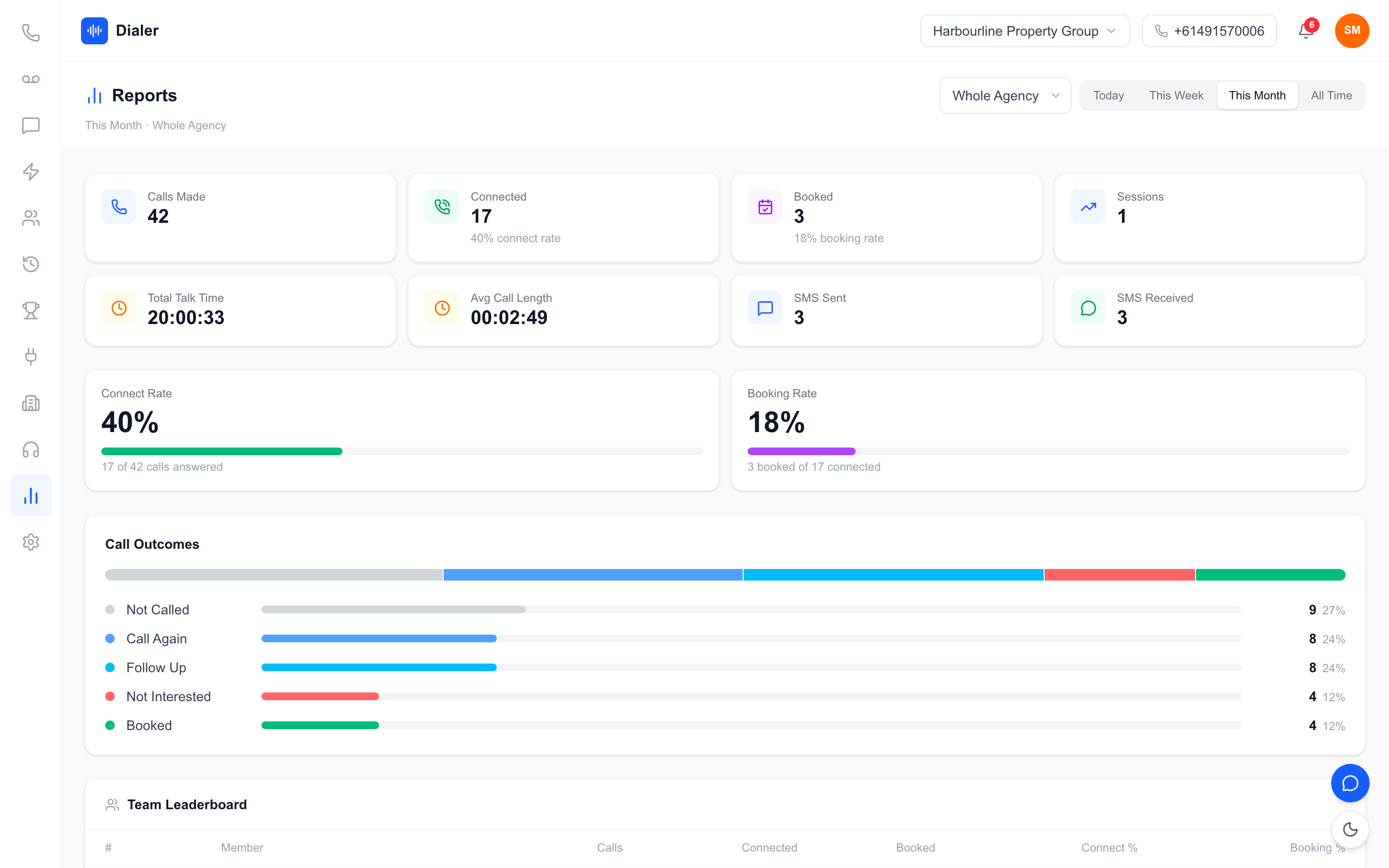
A sensible pattern is to rank on bookings, break ties on calls, and show the other numbers alongside so people can see why someone is ahead. That is exactly how the Team Leaderboard in Veyce Reports sorts: by appointments booked, then by calls made.
Show the supporting numbers next to the rank
A rank on its own invites arguments. Put the working on the board: calls, connected calls, bookings, connect rate (connected divided by calls) and booking rate (bookings divided by connected calls). When a rep in fourth place has the best booking rate on the team, that is worth talking about, and it is invisible if all you show is position.
Use points when you want to reward the whole process
Points let you weight different actions in one number. For example, a points system might give a little for each dial, a little more for a real conversation and a lot for a booking. The advantage is that a rep who did everything right but missed out on a booking still moves up. We cover points design in more depth in a separate guide, but the short version for a leaderboard is: keep the weights public, keep them stable for at least a month, and make bookings worth clearly more than anything else.
How live is live enough
Real time versus end of session
"Live" means different things in different tools, so check what a vendor means before you buy a live sales team leaderboard. Some boards refresh every few seconds. Others update when a rep finishes a session or saves a call outcome. For a ranking, updating as each call is logged is plenty: nobody needs to watch a position change mid-sentence. What matters is that the board is never a day old. If reps have to wait until tomorrow to see today's effort counted, the motivation effect is mostly gone.
Choose the time window deliberately
The window you rank over changes who wins:
- Today suits a call blitz or a power hour. Everyone starts at zero, so a new starter can top the board by lunch.
- This week is the best default for most teams. It is long enough to smooth out one bad day and short enough that last month's star cannot coast.
- This month lines up with targets and commission, but positions settle early and the bottom half can feel locked out by the second week.
- All time is a record book, not a motivator. Use it for milestones, not for daily ranking.
A worked example of window choice
This is an illustration, not data from any team. Assume a four-rep team where Rep A has been on the phones for a year and Rep D started on Monday. Over the month, Rep A has 40 bookings and Rep D has 2, so a monthly board shows Rep D last by a wide margin all month. On a weekly board reset each Monday, Rep D's 2 bookings this week sit against Rep A's 9, a gap that a good week can close. On a daily board during Thursday's power hour, Rep D can genuinely win. The underlying effort is identical; only the window changed what the board says. Start a free 7-day Veyce trial with 50 calling minutes included.
Running the board day to day
Put it where people already look
A live sales team leaderboard nobody opens does nothing. The board should be one click from where reps make calls, or on a screen the whole floor can see. Many teams open the day by putting the weekly board up for two minutes in the stand-up, naming the top three and one rep who improved the most. That last part matters: it gives the middle of the pack a reason to care.
Protect new starters and part-timers
Ranking a two-day-old rep against a five-year veteran on monthly bookings is demoralising and tells you nothing. Options that work:
- Start new reps on a calls or conversations board for their first fortnight, then move them onto bookings.
- Compare part-time reps on rates (connect rate and booking rate) rather than totals.
- Run short daily challenges where everyone resets to zero.
Watch for the behaviour the board creates
Every metric gets gamed eventually. A calls-only board can encourage reps to skip notes and rush wrap-up. A bookings-only board can encourage soft appointments that never turn up. Review the board alongside call recordings and booking show rates every week or two, and change the primary metric if you see the wrong habits forming. A leaderboard is a tool for managers, not a replacement for listening to calls.
Keep the tone competitive, not punitive
A live sales team leaderboard works when it celebrates. If the bottom of the board becomes the agenda for a performance meeting in front of the team, people stop engaging with it and start finding reasons to be off the phone. Talk about low numbers one to one, and use the public board for recognition. If you track performance publicly, Safe Work Australia's guidance on psychosocial hazards is worth reading alongside your own HR advice.
Veyce: leaderboards built into the dialler
Two leaderboards for two jobs
Veyce, a power dialler for Australian teams, has two leaderboards, because reps and managers need different things:
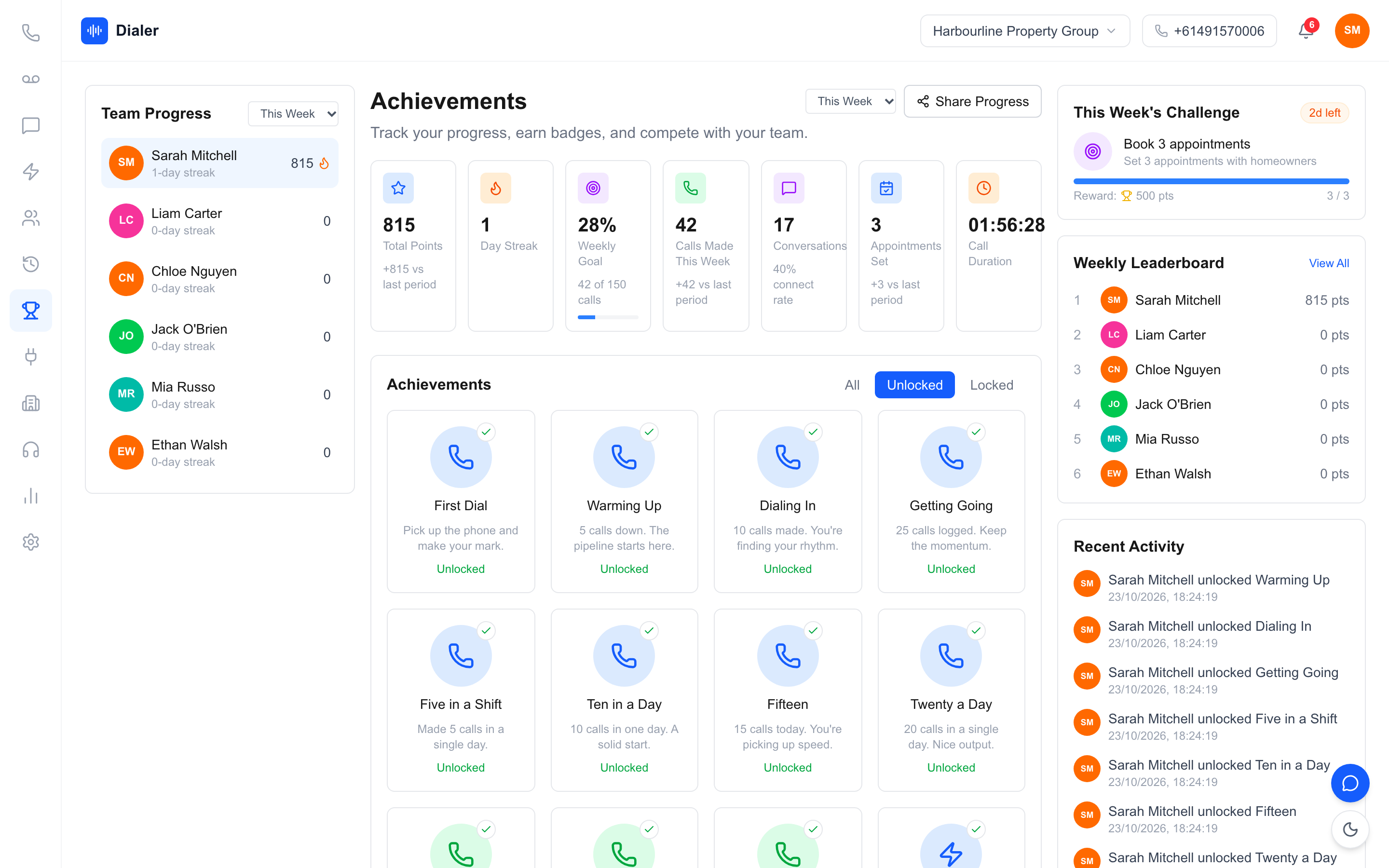
- Weekly Leaderboard (every rep). On the Achievements page, reps are ranked by points earned this calendar week. Points come automatically from calling: 10 per call, 5 per answered call, 5 for Owner Reached, 15 for Pitch Complete and 50 for setting an appointment. Beside it, the Team Progress list shows each rep's points and day streak for Today, This Week, This Month or All Time.
- Team Leaderboard (owners and managers). In Reports, with Whole Agency selected, every rep is listed with calls, connected, booked, connect % and booking %, ranked by bookings and then calls. Click a row to see that rep's own numbers for the same period.
Counts come from the calls themselves
Nobody self-reports. Calls, answered calls and appointments are counted from the dialler session as reps work, and the leaderboard shows the latest totals whenever someone opens it or changes the time range. The Achievements page also shows a Recent Activity feed of achievements unlocked across the team, which gives people something to react to between bookings.
A live view for managers on Growth and Agency
For a second-by-second view, owners and managers on Growth and Agency also get the Live monitor: who is online, each rep's calls as they happen, and today's calls, conversations and talk minutes per rep, refreshed every few seconds. It is not a ranking, but it answers "who is on the phones right now?" without walking the floor.
Plans and pricing
The leaderboard and team gamification are listed on the Team plan ($179 a month, 4 seats and 400 minutes included) and above; see Veyce plans and what each includes. Every plan includes calling minutes and a dedicated Australian number for your team.
Conclusion: make the board part of the day
A live sales team leaderboard works when it measures the right thing, resets often enough that anyone can win, and sits where reps already work. Rank on bookings with calls as the tie-breaker, show the rates beside the rank, use a weekly window by default and a daily one for blitzes, and keep the public tone celebratory. Then check the behaviour it drives against real call recordings.
If you want a board that fills itself from the dialler, start a free trial: 3 days from your first call and 100 calling minutes, no card. The trial covers one seat, so load a list, run a session of calls and open the Achievements page to see your calls counted; ranking a whole team needs a plan with more seats, from Team up. For more on how dialling speed affects the numbers on the board, read our comparison of a power dialler versus manual calling.
Frequently asked questions
What should a sales leaderboard rank reps on?
Most outbound teams get the best results ranking on appointments booked and breaking ties on calls made. Bookings are the outcome you care about, and calls show effort on days when bookings do not land. Put connected calls, connect rate and booking rate next to each rank so reps can see why someone is ahead. Avoid ranking on several metrics at once, because a board that mixes everything gives nobody a clear target to chase.
How often should a live sales team leaderboard update?
Updating as each call is logged is enough for a ranking. Nobody needs a position to change mid-sentence, but the board should never be a day behind, because effort that is not counted until tomorrow loses most of its motivating effect. For a true second-by-second view of who is on the phones, use a separate monitoring screen. In Veyce, managers on Growth and Agency get that from the Live monitor, while the leaderboard shows totals.
Should the leaderboard be daily, weekly or monthly?
Weekly suits most teams as the everyday board. It smooths out a single bad day but resets often enough that last month's top rep cannot coast. Daily boards work well for a call blitz or power hour because everyone starts at zero. Monthly boards line up with targets and commission, but positions tend to settle early, which can leave the bottom half of the team feeling locked out by the second week.
How do I stop a leaderboard demotivating new reps?
Do not rank a new starter against experienced reps on monthly bookings in their first weeks. Put them on a calls or conversations board for a fortnight, compare part-timers on rates instead of totals, and run short daily challenges where everyone resets to zero. In stand-ups, name the most improved rep as well as the top three. Keep conversations about low numbers private and use the public board for recognition, not criticism.
Does Veyce include a sales leaderboard?
Yes. Every rep sees a Weekly Leaderboard ranked by points on the Achievements page, with points earned automatically from calls, answered calls, Owner Reached, Pitch Complete and appointments. Owners and managers also get a Team Leaderboard in Reports, ranked by bookings then calls, with connect and booking rates. The leaderboard and team gamification are listed on the Team plan and above, and the free trial gives you 3 days from your first call with 100 calling minutes.