A sales dialler with call recording gives a sales manager something most never have: a reliable view of what actually happens on the phone. Dial counts and booking rates tell you that a rep is struggling; recordings tell you why. Yet plenty of teams switch recording on and then never build the habit of listening, so the recordings pile up unheard.
This guide is a manager's playbook for turning recordings into better calls. It covers what a sales dialler with call recording gives a manager, a simple weekly review routine, how to bring reps on board without making recording feel like surveillance, and how it works in Veyce. It is written for Australian teams, and it points to official sources on the recording and workplace rules rather than guessing at them.
What a sales dialler with call recording gives a manager
Evidence instead of impressions
Without recordings, feedback rests on what a manager happened to overhear and what a rep remembers. Both are patchy. A recording lets you and the rep listen to the same thirty seconds and agree on what happened: the question that opened the prospect up, or the moment the rep talked over an objection. Feedback grounded in a shared recording is easier to give and far easier to accept.
Recordings next to the numbers
Metrics show where to look; recordings show what to fix. If one rep connects as often as the rest of the team but books half as many appointments, the numbers have done their job. The next step is to listen to five of that rep's connected calls. A sales dialler with call recording that keeps the recordings beside the session numbers makes that a two-minute search rather than an afternoon.
A fair record for reps too
Recordings protect reps as much as they check them. When a customer claims they were promised something they were not, the recording settles it. When a rep's numbers dip during a hard week on a cold list, the recordings show the effort that went in. Make that point early, because it changes how reps feel about being recorded.
A faster start for new reps
A new starter usually learns by sitting next to someone for a week and hoping the good calls happen while they are listening. With a sales dialler with call recording, you can hand them a short playlist on day one: three strong openings, two calls where a top rep handled a price objection, and one call that went wrong and why. They hear real conversations from your market before they make their first dial, and they can replay the hard moments as often as they need.
A weekly call review playbook
Monday: pick the calls
Spend fifteen minutes choosing what to review, not listening yet. Scan last week's call summaries and outcomes and pick, for each rep, one booked call, one call that got to a real conversation but did not book, and one short call that ended early. Summaries make this quick, because you can read what happened on a call in a few seconds. Note the call, the rep and the one question you want the review to answer, such as "why did this prospect go quiet after the price?" A review with a question attached stays short and focused; a review without one turns into a general chat about the week.
Midweek: one-to-ones on two calls
In a twenty-minute one-to-one, play two of the chosen calls with the rep. Ask them what they heard before you say anything. Agree on one change only, such as asking a second question before pitching, and write it down. One change practised all week beats five pieces of advice forgotten by lunch.
Friday: one call for the whole team
Play one strong call at the Friday team meeting, ideally from a different rep each week. Pause at the key moment and ask the team what made it work. Over a quarter you build a shared library of good calls in your own market, with your own suburbs, products and objections.
Keep the routine light
Here is a worked example, with assumptions stated. For a team of four reps, three calls each is twelve calls chosen on Monday, eight played in one-to-ones and one at Friday's meeting. At an assumed three to four minutes a call plus discussion, that is roughly two and a half to three hours of manager time a week. Scale the number of calls to the time you can genuinely protect; a routine that survives beats an ambitious one that stops in week three.
Getting reps on board with recording
Explain the purpose first
Tell the team why calls are recorded before the first recording is made: to improve the script, to share good calls, to settle disputes and to keep an accurate lead history. Be specific about who can listen. Reps who hear the purpose from you, rather than discovering recordings exist, are far more likely to treat them as a tool.
Know the rules for customers and staff
Recording phone calls in Australia can be covered by the federal Telecommunications (Interception and Access) Act 1979 and by state and territory laws, which differ. The OAIC notes that employers who monitor staff must follow the relevant Australian, state or territory laws, including those on recording phone conversations, and that some states have specific workplace surveillance laws; see its page on workplace monitoring and surveillance. Many businesses tell customers at the start of each call that it is recorded. This is general information, so get advice on what to tell both customers and staff.
Agree what recordings are not for
Say plainly what you will not do: play a rep's weak call to the whole team without their agreement, or review calls only when looking for a reason to criticise. Then stick to it. Trust built here is what keeps reps from drifting to their personal mobiles for the calls they would rather nobody heard.
Veyce: a sales dialler with call recording and team metrics
Recording, transcripts and summaries
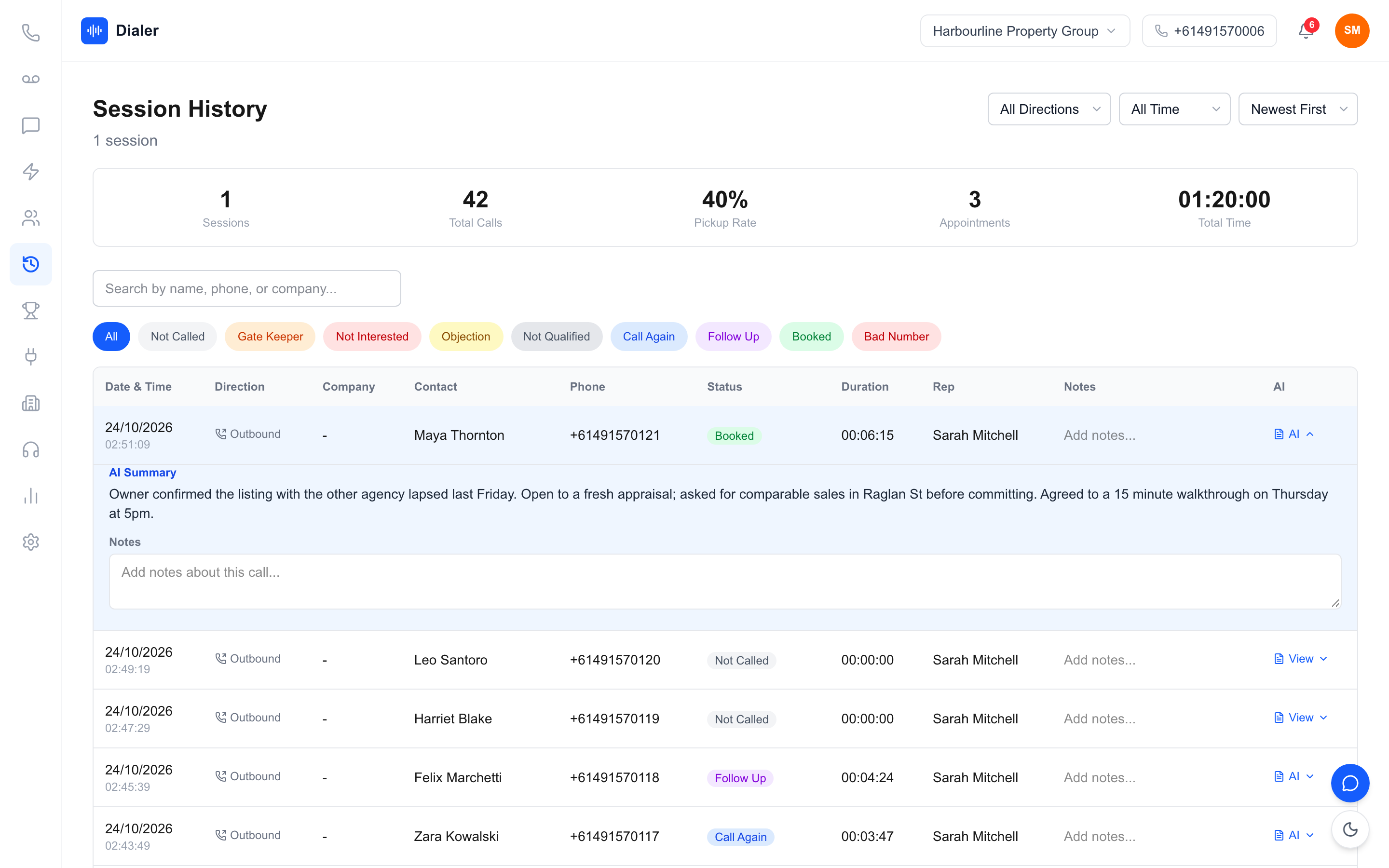
In Veyce, recording is switched on in Settings. Calls made through your team's dedicated Australian number are then recorded, and after each call ends the recording is transcribed and a two or three sentence AI summary is attached, usually within a minute or two. Transcription happens only after the call and only on recorded calls; calls from a rep's own phone, where allowed, are not recorded. Recordings can only be played by signed-in members of your organisation.
Live session metrics and leaderboards
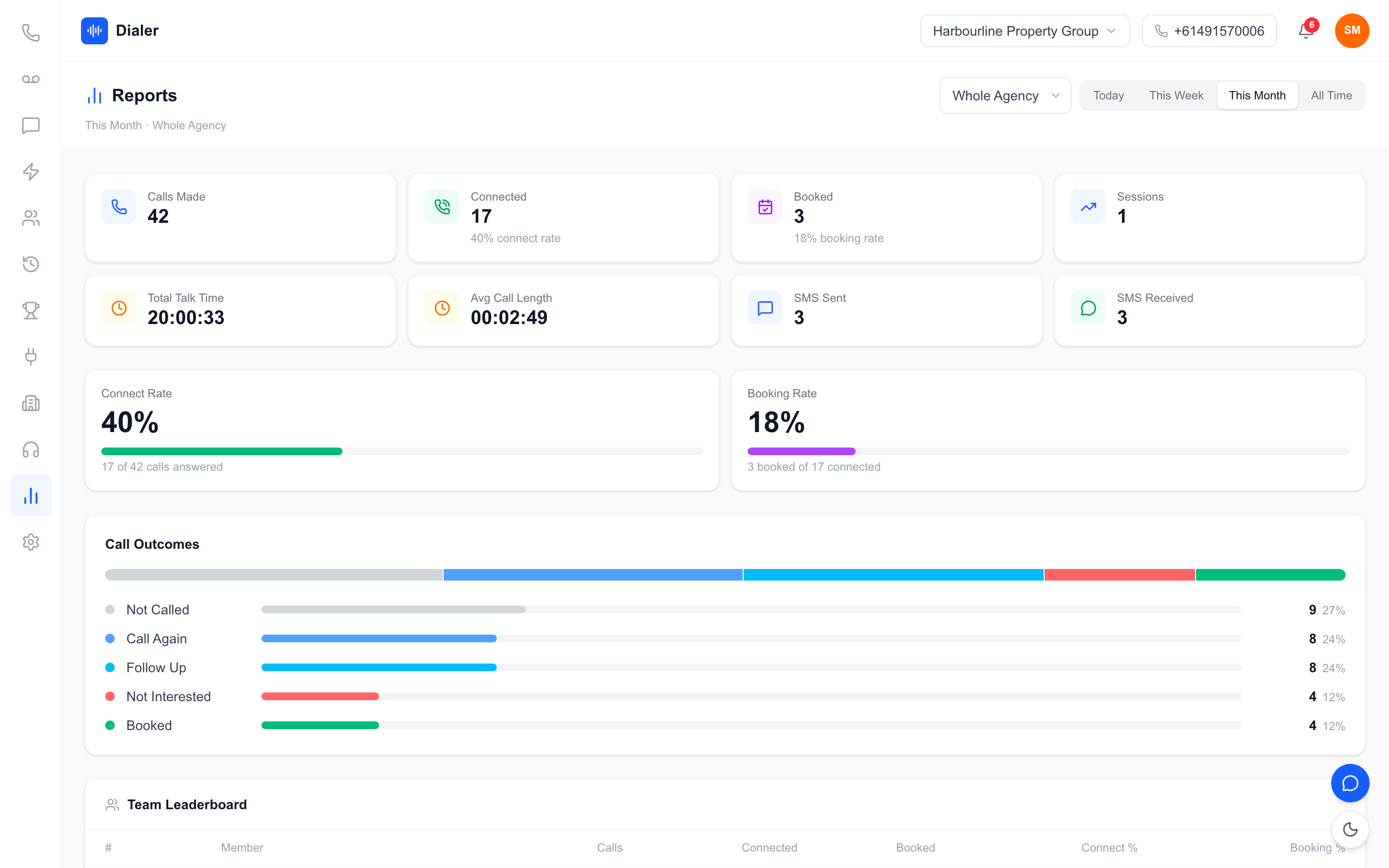
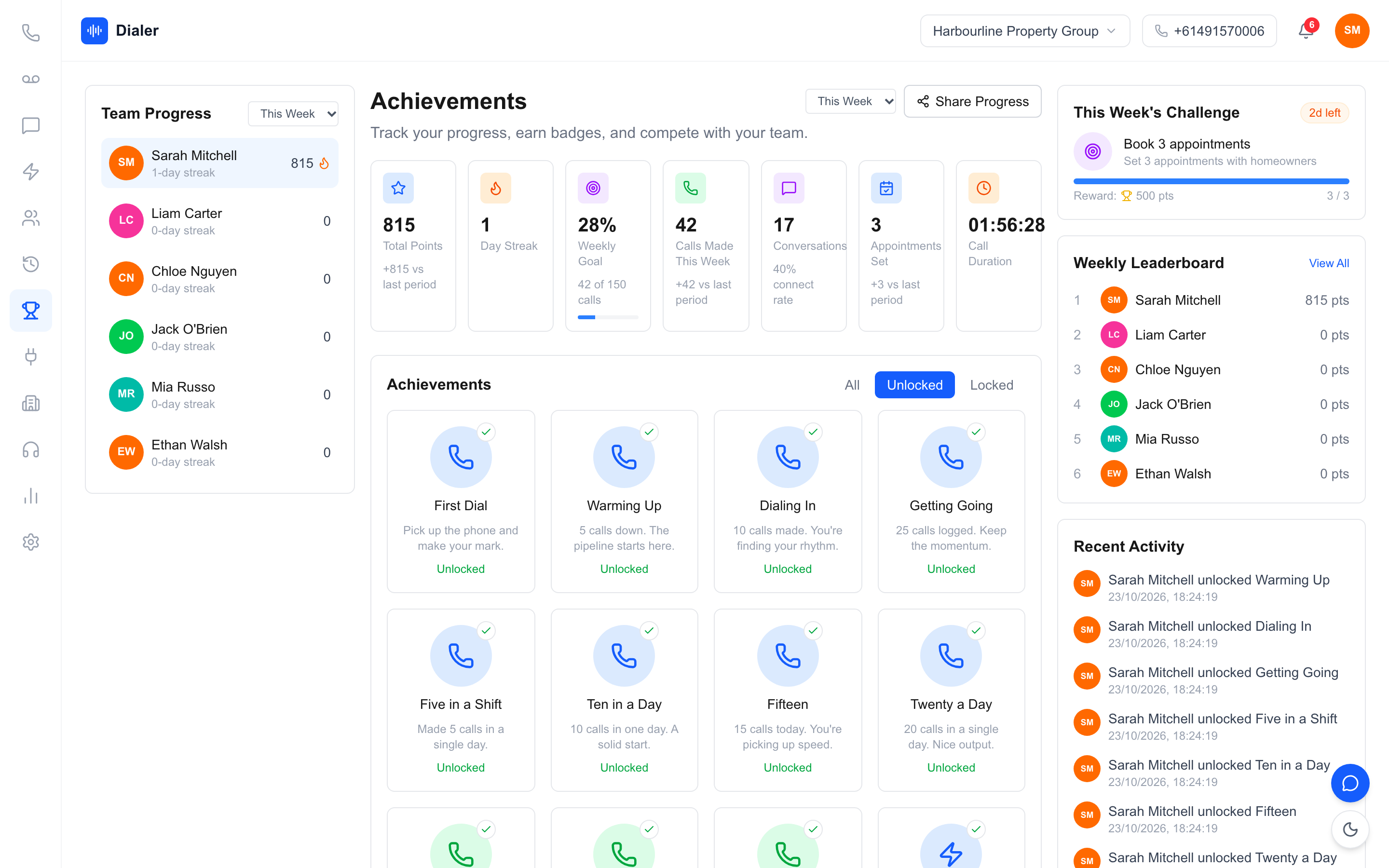
Veyce shows session metrics such as total calls, pickup rate, appointments and time on the phone, plus a weekly leaderboard that ranks reps by points. Use the numbers to decide whose calls to review, then open the recordings from session history. That pairing, the numbers to find the question and the recording to answer it, is the core of the playbook above.
Plans for growing teams
Recording, transcripts and summaries are included on Team, Growth and Agency: Team at $179 a month covers four seats, Growth at $449 covers ten and Agency at $1,099 covers 25, with extra seats at $29. Solo does not include call recording. See current Veyce plans, the full Veyce power dialler tour, or how mortgage brokers use it for prospecting.
Make recordings part of the week
A sales dialler with call recording is only as useful as the routine around it. Pick the calls on Monday, review two per rep midweek, play one good call on Friday, and keep the promises you made about how recordings are used. If you are still comparing tools, our checklist on how to choose a power dialler in Australia covers the rest.
To try Veyce on your own list first, start a free 3-day Veyce trial, counted from your first call, with 100 calling minutes and no card, and test the dialler, lead import, scripts and session flow. Call recording with AI transcripts and summaries, which the playbook runs on, comes on the Team, Growth and Agency plans.
Frequently asked questions
Why should a sales team use a sales dialler with call recording?
Because metrics only show that something is wrong, while recordings show what. A sales dialler with call recording keeps each recording on the call it belongs to, beside the rep, the outcome and the session numbers, so a manager can find the right calls in minutes. Recordings also settle customer disputes, give new reps real examples to learn from, and keep an accurate history of every lead.
How many calls should a manager review each week?
Enough to keep the habit going, and no more. A workable starting point is three calls per rep chosen each week, two of them reviewed with the rep in a short one-to-one and one good call shared with the team. For a four-rep team that is roughly two and a half to three hours of manager time a week, based on calls of three to four minutes. Scale it to the time you can protect.
Do I need to tell my staff their calls are recorded?
Get advice for your situation. The OAIC says employers who monitor staff must follow the relevant Australian, state and territory laws, including laws on recording phone conversations, and some states have specific workplace surveillance laws. Customers are a separate question: many businesses tell them at the start of each call that it is recorded. Telling reps the purpose of recording early is also good practice for trust.
Are calls from a rep's own phone recorded in Veyce?
No. Veyce can allow reps to call from their own phone over their own carrier plan, but those calls are not recorded, transcribed or summarised. Calls made from the dialler through your team's dedicated Australian number are recorded once recording is switched on in Settings, and are transcribed and summarised after each call ends. For a complete review library, ask reps to place sales calls through the team number.
What does a sales dialler with call recording cost with Veyce?
Recording, AI transcripts and summaries are included with no add-on on the Team, Growth and Agency plans, while Solo does not include call recording. Solo is $49 a month for one seat, Team $179 for four, Growth $449 for ten and Agency $1,099 for 25, each with calling minutes included and extra seats at $29. The free 3-day trial, counted from your first call, includes 100 calling minutes and needs no card, so you can test the dialler, lead import, scripts and session flow on your own list. Call recording is not part of the trial.