A power dialler compliance checklist turns a pile of rules into a routine your team runs before, during and after every calling session. A power dialler makes reps faster, which is the point, but speed also means a mistake in the list or the timing gets repeated across hundreds of calls before anyone notices. A short power dialler compliance checklist that the team lead ticks off each week catches most of those mistakes early, and it gives new reps a clear picture of how the team works from day one.
Below is a practical checklist for Australian outbound sales teams using a power dialler, grouped by stage. Each item that rests on a rule links to the official source on donotcall.gov.au, acma.gov.au or legislation.gov.au, so you can check the detail yourself. It is general information, not legal advice: your business, your industry and the way you get your leads all affect what applies to you, so confirm your obligations with an adviser.
Before the list goes into the dialler
1. Know which rules apply to your calls
The first item on any power dialler compliance checklist is confirming your calls are telemarketing calls. Section 5 of the Do Not Call Register Act 2006 defines them by purpose, and the register's industry FAQs say a call with a commercial purpose is covered even if that is not its main purpose. For most sales teams, assume every outbound sales call is in scope. Check: has someone in the business read the industry overview on donotcall.gov.au this year?
2. Wash the list and record the date
Every list needs a Do Not Call Register wash before it is dialled, unless you are relying on consent or an exemption. The register's washing process overview explains how to set up an account and subscription. Checks:
- The list was washed, and the wash result file is saved.
- The wash date is on the file name and recorded against the list.
- Numbers the wash marked as registered are out of the list before import, or cleared in the dialler straight after.
3. Watch the 30-day window
The register's industry FAQs say a wash in the 30 days before a call, where the register did not show the number as registered, means no breach. Check: is any list in the dialler older than 30 days since its wash? If yes, pause it and re-wash the uncalled numbers.
4. Check consent records where you rely on them
If you call registered numbers because a person agreed to it, keep the record of who agreed, when and how. ACMA's guidance on using the register says express consent with no set period is taken to expire three months after it was given. ACMA has also published a statement of expectations on consent. Check: does every consent-based lead have a date, a source and an expiry?
Setting up the calling session
5. Calling hours for each lead's time zone
The register's industry standards page summarises telemarketing calling hours as weekdays 9am to 8pm and Saturdays 9am to 5pm, with no calls on Sundays or national public holidays unless the consumer has agreed. The full text is in the Telemarketing and Research Calls Industry Standard 2017. Australia has several time zones and daylight saving is not observed in every state, so during daylight saving a 9am start in Sydney is 8am in Brisbane and 6am in Perth. Checks:
- Sessions are planned around the lead's local time, not the office clock.
- National public holidays are blocked out in the team calendar.
- Lists that cross states are split or sorted by time zone.
6. Caller identification on every call
The industry standard requires calling line identification to be enabled on every call, and the register's industry standards page says a return-contact number must stay available for at least 30 days. Check: does every outbound call show a number a lead can ring back, and does someone answer or return those calls?
7. Script opening that says who you are
The industry standard also covers information a caller must give. Check: does your script open with the rep's name, the business name and the reason for the call, and does every rep know how to give the business's contact details if asked? Our cold calling tips for Australian sales teams cover how to open without sounding scripted. Compare Veyce's per-team plans and what each includes.
During and after each call
8. End the call when asked
The register's industry standards page says a caller must end the call immediately when the person asks, or otherwise indicates they do not want to continue. Check: are reps trained to end politely without a second pitch, and is there a "do not call again" outcome in the dialler?
9. Keep a suppression list
A do-not-call-again request should apply to every future list, not only the one being worked. Check: is there one central suppression list, and is it applied before every import?
10. Follow-up texts follow the spam rules
Texts after a call are commercial electronic messages. ACMA's avoid sending spam page says you need consent, must identify yourself as the sender with contact details, and must make it easy to unsubscribe. Checks:
- Reps only text leads who agreed to it on the call, and log that agreement.
- Every marketing text names the business and includes an unsubscribe option.
- Unsubscribe requests are actioned and recorded.
11. Call recording and notes
If you record calls, decide how reps tell people the call is recorded, and get advice on the consent rules for the states you call into. Check: is the recording notice in the script, and are recordings and summaries stored only where the team can access them?
Records and review
12. Keep evidence together
The register's Compliance and Breaches page explains how breaches are handled and the penalties that can apply. Check: for any number, can you produce the wash date, the list it came from, the call times and outcomes, and any consent record within an hour?
13. Contractors and outsourced callers
The industry FAQs say both the caller and the business requiring the call must comply. Check: do contractor agreements require compliance with the legislation, and do contractors only get washed, dated lists?
14. A monthly review
Once a month, pick a sample of calls and check them against this power dialler compliance checklist: time of call in the lead's zone, wash date, outcome logged, any text sent with consent. Worked example, with assumptions stated: a four-rep team making 150 dials each per day across 20 days makes about 12,000 dials a month, so a sample of 20 calls takes under an hour and still catches repeated mistakes.
Veyce: how the dialler supports this checklist
Working with your wash
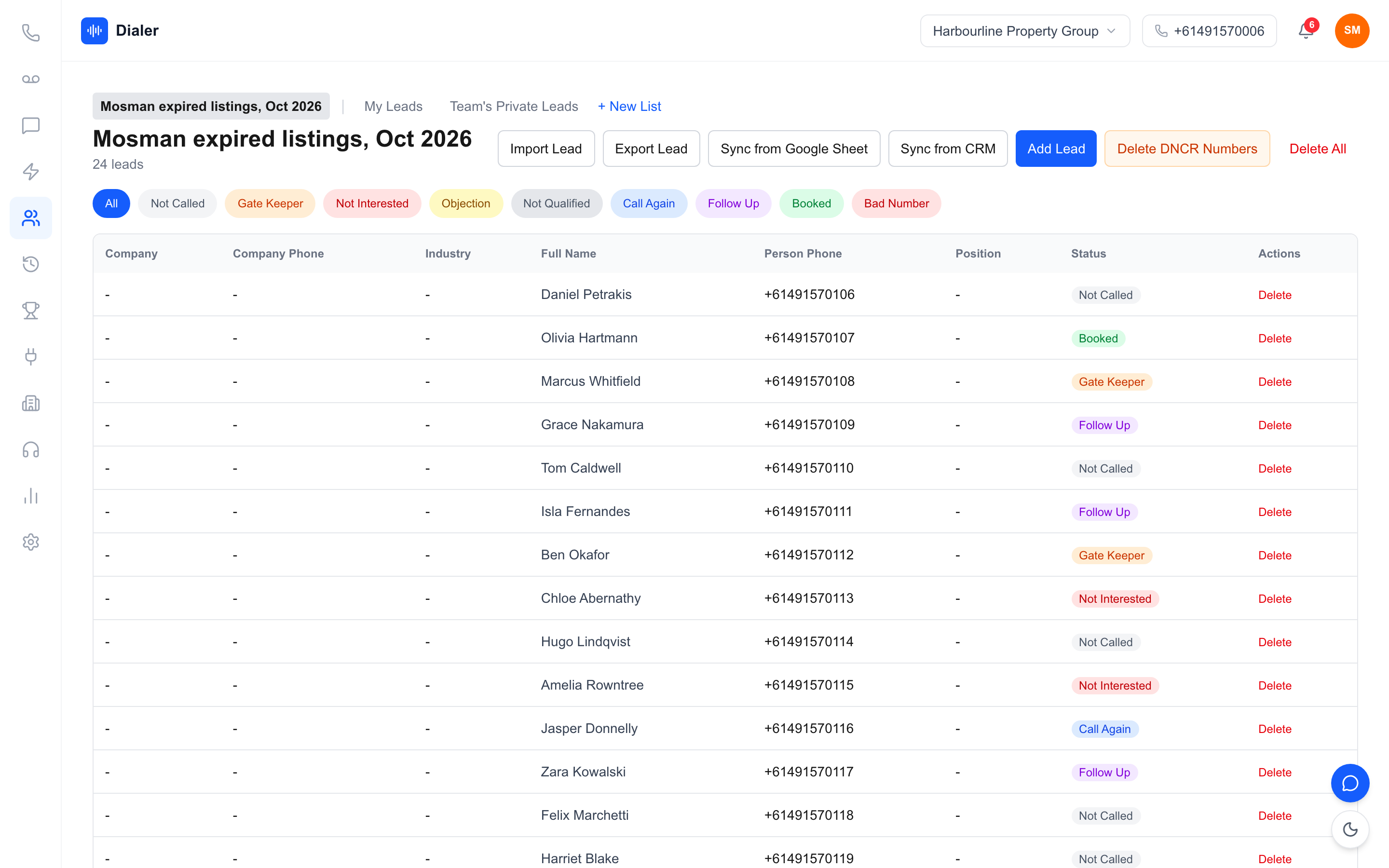
The wash itself stays with your team, and no dialler can meet your obligations for you. Veyce works with your wash rather than replacing it: numbers the wash marks as registered are left out of PriceFinder imports, and the Delete DNCR Numbers button clears flagged leads. That covers item 2's last check in a couple of clicks once your wash is done.
Call records you can review
In Power Dialler mode, Veyce rings one lead at a time and every call, outcome and recording is logged against the lead. On the Team, Growth and Agency plans, recorded calls get an AI transcription and summary after the call, which makes item 14's monthly review faster: read the summary, then play the recording only where you need to. Texts go through the SMS inbox on your team's dedicated Australian number, so the history sits with the lead.
Parallel Dialer hours
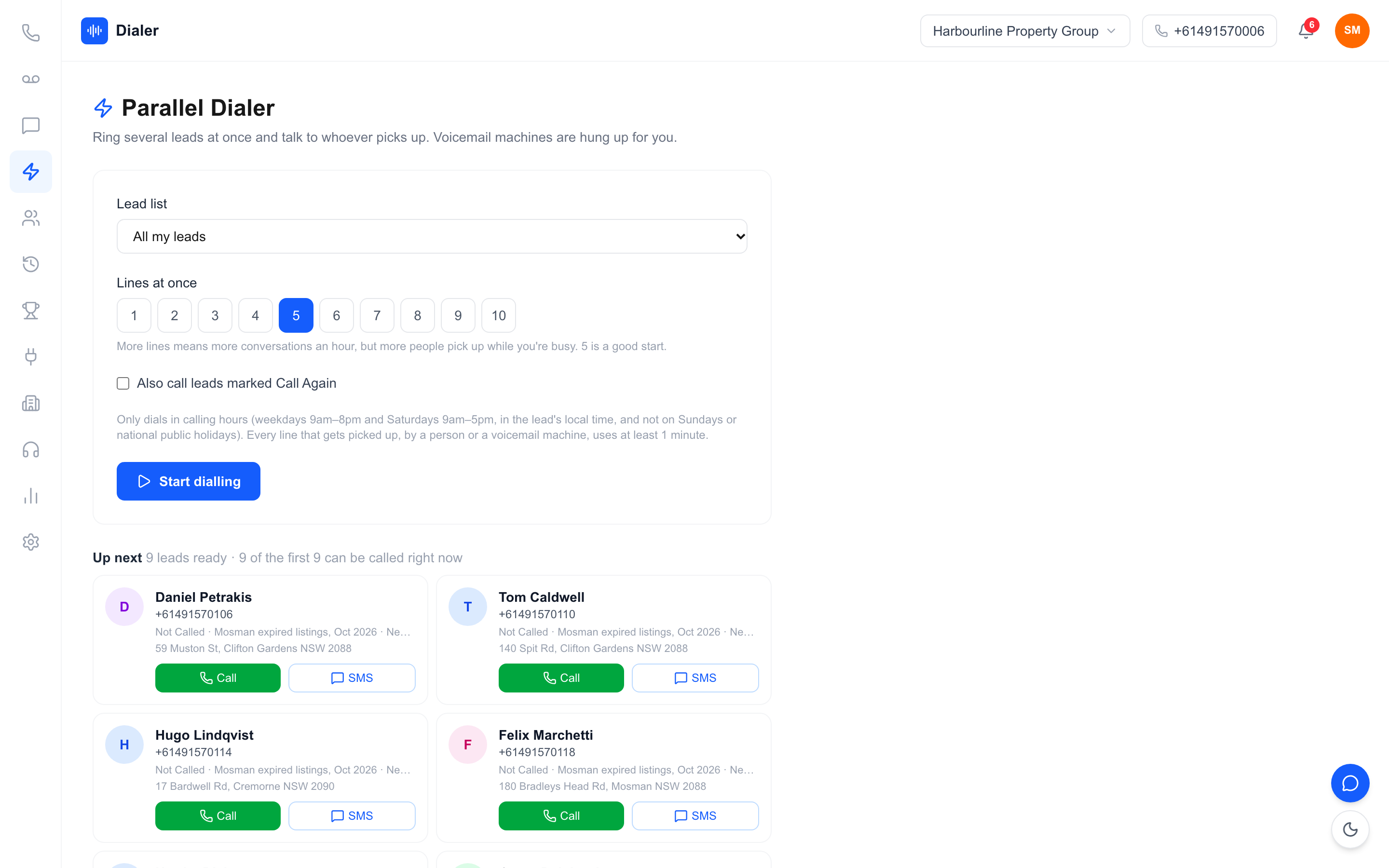
The optional Parallel Dialer add-on on Growth and Agency (+$99 a seat, up to 5 leads at once on Growth and up to 10 on Agency) only places calls weekdays 9am–8pm and Saturdays 9am–5pm, in the lead's local time, and not on Sundays or national public holidays. In Power Dialler mode the rep starts each session, so item 5 stays with your team. See how the modes compare on the Veyce power dialler page.
Conclusion: run your power dialler compliance checklist weekly
A power dialler compliance checklist only helps if it becomes routine: wash and date every list, plan sessions around the lead's local time, end calls when asked, follow the spam rules for texts, and keep records you can find. Print the fourteen items, assign an owner for each one, and review a sample each month. When a check fails, fix the process that let it happen, not just the one call, and add a line to the checklist if the gap is new. Over a few months the power dialler compliance checklist becomes a short record of how your team calls, which is also useful when you onboard reps or answer a question from a lead. If you are comparing tools, our guide on how to choose a power dialer in Australia lists what to ask vendors, and you can try Veyce with a free 3-day trial (counted from your first call), 100 calling minutes and no card.
Start a free 7-day Veyce trial with 50 calling minutes included →
Frequently asked questions
What should be on a power dialler compliance checklist?
At a minimum: a Do Not Call Register wash with a recorded date, a re-wash before 30 days, consent records where you rely on consent, calling hours planned in the lead's local time, caller identification on every call, an honest script opening, ending calls when asked, a suppression list, spam rules for follow-up texts, and records you can find. This is general information, so check donotcall.gov.au and acma.gov.au for detail.
Can a power dialler take care of compliance for us?
No tool can do that on its own. Your obligations rest on how you get leads, wash lists, plan calling times, run calls and keep records. A dialler can make parts of the routine easier, such as clearing flagged leads or keeping call records with each lead. With Veyce the wash stays with you: Veyce works with your wash rather than replacing it. Confirm your obligations with an adviser and the official guidance.
What calling hours apply to telemarketing calls in Australia?
The Do Not Call Register's industry standards page summarises them as weekdays 9am to 8pm and Saturdays 9am to 5pm, with no calls on Sundays or national public holidays unless the consumer has agreed to a call at that time. The rules come from the Telemarketing and Research Calls Industry Standard 2017 on legislation.gov.au. Plan around the lead's local time, since an interstate list can span several time zones.
How often should we re-wash our calling lists?
The register's industry FAQs say a wash in the 30 days before a call, where the register did not show the number as registered, means no breach. So re-wash any list before it turns 30 days old if you are still calling it. Export the uncalled numbers, wash them, and clear any newly flagged leads before the next session. Keep each wash result file with its date.