Sales gamification software adds game mechanics such as points, badges, streaks and challenges to the everyday work of selling, so reps get small, frequent wins for doing the activities that lead to deals. For outbound teams it is mostly about the phone: rewarding the next dial, the next real conversation and the next booked appointment, instead of waiting for a monthly commission cheque to do all the motivating.
This guide is for Australian sales managers and business owners deciding whether gamification is worth it, how to design a points system that rewards the right behaviour, and what to look for in the software. It is written for teams that call for a living, in real estate, solar, finance, insurance, telco and B2B services, and it applies whether you buy a standalone tool or use the gamification built into your dialler.
What sales gamification software does
The core mechanics
The broader idea, applying game design to non-game work, is known as gamification. Most sales products combine the same handful of ideas:
- Points that turn different activities into one score, weighted by how much each one matters.
- Badges or achievements that unlock at milestones, such as a first booking or a hundred calls in a week.
- Streaks that count consecutive days of activity, which reward showing up every day.
- Challenges with a target and a deadline, often weekly, sometimes with bonus points attached.
- Leaderboards that rank reps on points or results.
The mechanics matter less than how they connect to real work. A badge for logging in is noise. A badge for a rep's first three-appointment day is something they will mention at the next stand-up.
Why it suits outbound calling
Outbound calling is repetitive and the feedback loop is slow. A rep can make forty calls before one turns into a meeting, and the commission on that meeting may land weeks later. Gamification fills the gap with immediate, visible progress: every dial moves a number, every conversation moves it a bit more. That is why it tends to work better on the phones than in long-cycle field sales, where the activities are harder to count.
What it will not fix
Points do not fix a bad list, a weak script or a pitch that does not land. If reps are not booking because the offer is wrong, a game will only make them dial the wrong offer faster. Treat sales gamification software as a way to sustain good habits, not as a replacement for training and listening to calls.
Designing points that reward the right calls
Weight outcomes above activity
The most common mistake is rewarding volume so heavily that reps chase dials and skip the conversation. A better structure gives a small reward for activity and a much larger one for outcomes. As one real example, here is how Veyce's built-in points are weighted:
| Action | Points |
|---|---|
| Call made | 10 |
| Answered call | 5 |
| Owner Reached | 5 |
| Pitch Complete | 15 |
| Appointment set | 50 |
One appointment is worth five calls, which keeps volume valuable without letting it dominate.
A worked example of how weights change behaviour
This is an illustration using the table above, not data from any team. Assume Rep A makes 120 calls, has 30 answered calls and books 2 appointments in a day: that is 1,200 + 150 + 100 = 1,450 points before any Owner Reached or Pitch Complete taps. Rep B makes 80 calls, has 25 answered calls and books 5: that is 800 + 125 + 250 = 1,175 points. Rep A still wins on these weights, because calls are worth 10 each. If your priority is bookings, you might decide the appointment weight should be higher in your own system, or you might rank your bookings board separately, as Veyce's manager Team Leaderboard does. The point of the exercise is to run the numbers on a typical day before you launch, so the winner is the rep you want to win.
Keep the rules public and stable
Reps should be able to work out their own score. Publish the weights, explain any manual counters, and do not change the rules mid-month. If a change is needed, announce it a week ahead and start it at a natural reset, such as Monday.
Watch for gaming
Anything that is counted will be optimised. Calls can be padded with quick hang-ups; manual counters can be tapped generously. Two simple checks catch most of it: compare call counts with talk time, and spot-check a few calls behind each rep's manual counters against the recordings. If a rep's points rise but their bookings do not, look at the calls before you look at the leaderboard.
Choosing sales gamification software
Built into the dialler or a separate tool
Standalone gamification platforms connect to your CRM and phone system and pull activity from them. They can be very flexible, but they add another subscription, another integration to maintain and another place for numbers to disagree. Gamification built into the dialler counts calls where they happen, so there is nothing to sync. For a team whose main activity is the phone, built-in is usually simpler.
Questions to ask any vendor
- Where does the activity data come from, and is anything self-reported?
- Can reps see their own progress without asking a manager?
- Are there weekly resets, so a new starter can compete?
- Can managers see results by rep for today, this week, this month and all time?
- Does it include a challenge or goal feature, and can it reward outcomes, not just calls?
- What does it cost per seat, and is it included in the plan or an add-on?
Run a short trial with real calling
Gamification is easy to like in a demo and harder to judge in theory. Run it for a week with real lists and watch two things: whether reps open the progress screen without being told, and whether bookings hold up while call counts rise.
Veyce: gamification inside the power dialler
Points, streaks and roughly 300 achievements
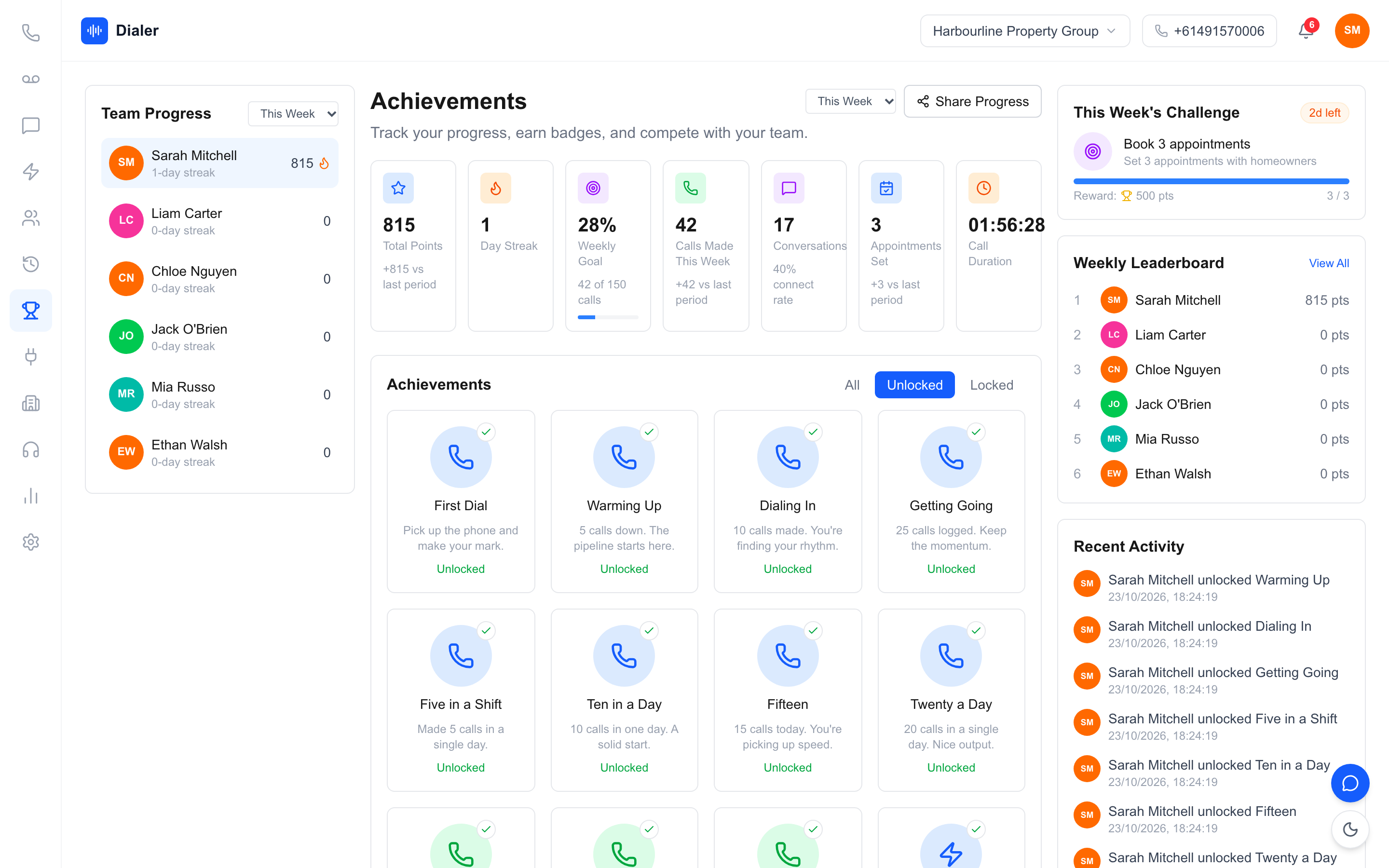
In Veyce, a managed power dialler for Australian sales teams, gamification lives on the Achievements page that every rep can open. It shows total points, a day streak, a weekly goal of 150 calls, calls made, conversations with connect rate, appointments set and call duration, each with a "vs last period" comparison. There are around 300 achievements in 22 series, covering total calls, calls in a day, week, month and session, conversations, appointments, Owner Reached, Pitch Complete, calling streaks, points, sessions and active calling days. They unlock automatically as the numbers add up, with All, Unlocked and Locked tabs.
Weekly challenge and leaderboard
Every week there is a challenge, "Book 3 appointments", worth a 500-point reward, with a countdown of days left. The Weekly Leaderboard ranks reps by points earned this calendar week, and a Recent Activity feed shows achievements as teammates unlock them. Click any rep in Team Progress to see their stats and achievements for any time range.
Counted from the calls, not self-reported
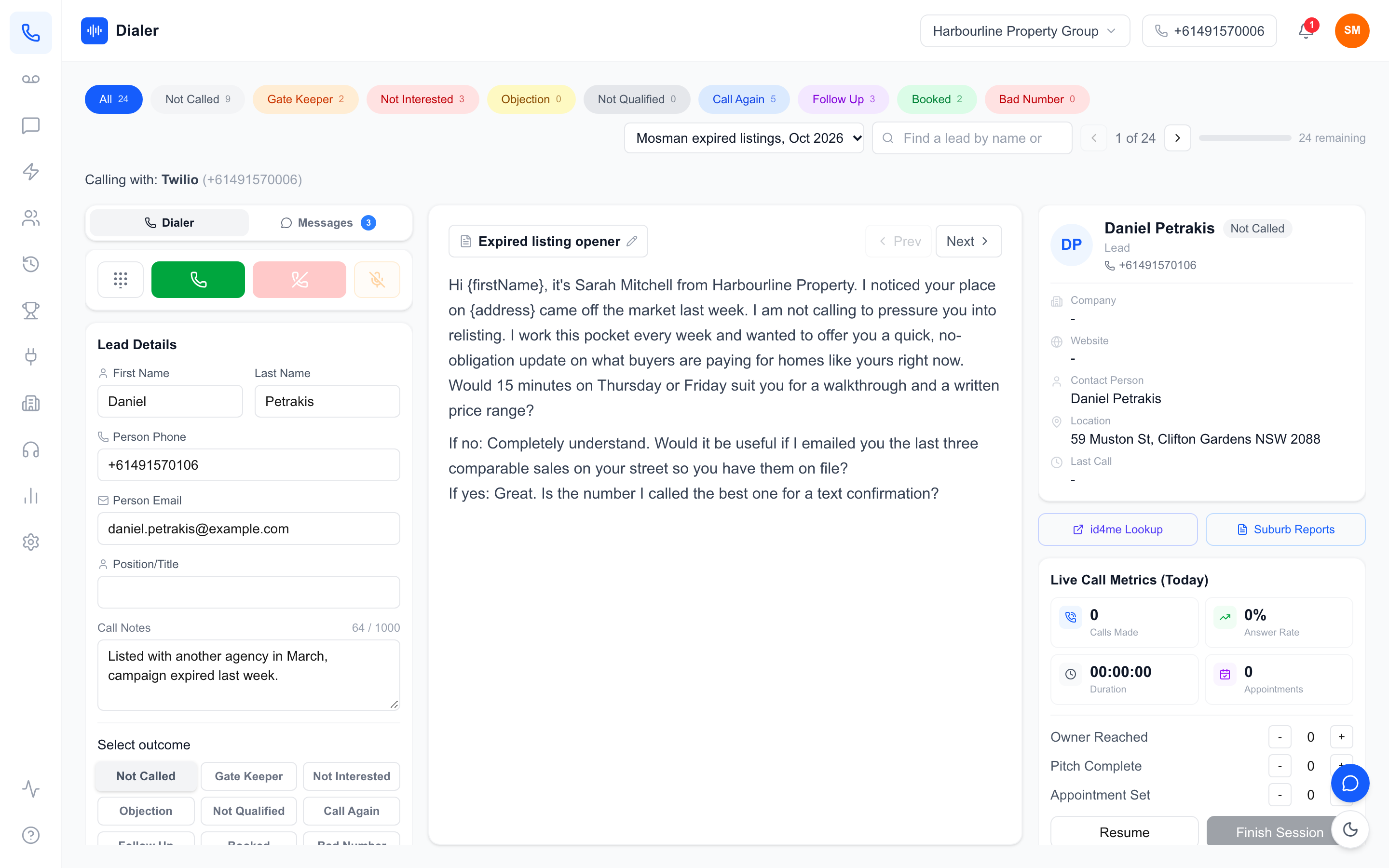
Calls, answered calls and appointments are counted from the dialler session. Owner Reached and Pitch Complete are counters the rep taps on the dialler during a session. Owners and managers can compare those manual counts against call recordings and the AI summaries that arrive after each recorded call.
Which plans include it
The Solo plan ($49 a month) lists gamification with XP and streaks; the Team plan ($179 a month, 4 seats) adds the leaderboard and team gamification; Growth ($449 a month, 10 seats) lists the full gamification suite. Compare them on the Veyce pricing page.
Conclusion: reward the calls that lead somewhere
Sales gamification software works when it rewards the habits that produce meetings: steady daily calling, real conversations and booked appointments. Weight outcomes well above activity, publish the rules, reset weekly so everyone can compete, and check the numbers against recordings so the game stays honest. Built-in gamification in the dialler avoids a separate integration and counts calls where they happen.
To see it for yourself, start a free trial: 3 days from your first call and 100 calling minutes, no card. The trial covers one seat, so run a session, then open the Achievements page to see your points and streaks; competing as a team needs a plan with more seats, from Team up. If you sell property, see how the same tools fit real estate agencies, and for scripts and openers read our cold calling tips for Australian teams.
Frequently asked questions
What is sales gamification software?
It is software that adds points, badges, streaks, challenges and leaderboards to sales activity. Reps earn points for actions such as calls, conversations and booked appointments, unlock achievements at milestones and compete on weekly challenges. For outbound teams the point is to give fast, visible feedback in work where the real payoff, a signed deal or a commission, can be weeks away. It works best when it rewards outcomes, not just activity.
Does gamification actually work for sales teams?
It can help sustain good habits, particularly steady daily calling, but it does not fix a weak list, script or offer. The teams that get value from it reward outcomes as well as activity, keep the rules public, reset regularly so new reps can compete, and check the numbers against call recordings. Trial it for a week with real calling and watch whether reps use the progress screen unprompted and whether bookings hold up.
How should I weight points in a sales game?
Give a small reward for activity and a much larger one for outcomes. In Veyce, for example, a call is worth 10 points, an answered call 5, Owner Reached 5, Pitch Complete 15 and an appointment 50. Before launching your own system, work out the scores for two typical reps on a normal day. If the rep with more bookings does not come out ahead and that matters to you, raise the outcome weight or rank bookings separately.
Should gamification be a separate tool or built into the dialler?
A standalone platform can be flexible but adds a subscription, an integration to maintain and another place for numbers to disagree. Gamification built into the dialler counts calls where they happen, so nothing needs syncing and nobody self-reports. For teams whose main activity is the phone, built-in is usually simpler. If most of your selling happens away from calls, a separate tool connected to your CRM may suit better.
What gamification does Veyce include?
Veyce has an Achievements page with points, a day streak, a weekly goal of 150 calls, around 300 achievements in 22 series, a weekly Book 3 appointments challenge worth 500 points, a Weekly Leaderboard and a Recent Activity feed. Calls, answers and appointments are counted from the dialler. Solo lists XP and streaks, Team adds the leaderboard and team gamification, and the free trial gives you 3 days, counted from your first call, and 100 calling minutes.