How many calls should a sales rep make a day? Ask ten sales managers and you will hear ten numbers, from 40 to 200, each delivered with total confidence. The honest answer is that the right number is not a benchmark you copy. It is a figure you calculate from your own revenue target and your own conversion rates, then check against the hours your reps really have on the phone.
This guide shows the calculation step by step, with a worked example you can copy into a spreadsheet. It also covers the limits on any daily target, the difference between a dial and a conversation, and how to set a number reps will respect and not game. The example figures are illustrations, not industry averages.
How many calls should a sales rep make a day? Start from the target
Work backwards from revenue
A daily call target is the last line of a sum that starts with money. You need four of your own numbers: the monthly revenue each rep is responsible for, the average sale value, the share of booked meetings that become sales, and the share of conversations that become booked meetings. If you do not know them yet, two weeks of honest call outcomes will give you a first estimate.
A worked example
Take a rep with a $40,000 monthly target and an average sale of $4,000. That is 10 sales a month. If one in four meetings closes, the rep needs 40 meetings. If one conversation in eight turns into a meeting, that is 320 conversations. If one dial in five reaches a real person, that is 1,600 dials a month. Across 20 working days, the answer is 80 dials and 16 conversations a day.
Change any one rate and the answer moves a long way. Lift the meeting rate from one in eight to one in six and the same target needs 60 dials a day, not 80. That is why coaching the conversation is often worth more than demanding more dials.
Dials, connects and conversations are different numbers
Most arguments about call targets are really arguments about definitions. Agree on three:
- A dial is any outbound attempt, answered or not.
- A connect is any call a person answered, including gatekeepers and wrong numbers.
- A conversation is a connect with the right person that lasted long enough to make the pitch.
Set the target on dials if you must, but manage on conversations. Our guide to sales call performance metrics covers how to calculate each one.
What limits how many calls a rep can make
Real calling time is smaller than the working day
An eight-hour day is not eight hours of calling. Take out the team meeting, lunch, email, CRM updates, quotes and booked appointments, and many reps have three to four hours of real phone time. Measure it before you set a target. A rep with three calling hours and a target that needs five will either miss it or fake it.
Manual dialling versus a dialler
How fast a rep moves from one call to the next sets the ceiling. Dialling by hand from a spreadsheet means finding the row, typing the number, waiting through the ring, then writing up the result before starting again. A power dialler removes most of that gap by placing the next call as soon as the last outcome is recorded. The saving is in the minutes between calls, not in talking faster. We compare the two in detail in power dialler vs manual calling.
To find your team's real pace, time one rep for one hour on a normal list and count the dials. That figure multiplied by real calling hours is the most a daily target can honestly be.
List quality and conversation length
Two more things bend the number. A list full of disconnected numbers produces plenty of dials and no conversations, so a rep on bad data can hit target and achieve nothing. Long conversations work the other way: a rep selling a complex service might have six 20-minute calls in a morning and be the most productive person on the floor. A target that punishes that rep for a low dial count is measuring the wrong thing.
Calling hours and who you may call
The clock also sets a limit. The Do Not Call Register's industry standards page summarises telemarketing calling hours as weekdays 9am to 8pm and Saturdays 9am to 5pm, with no calls on Sundays or national public holidays unless the person has agreed, measured in the local time of the person being called. A target that can only be reached by ringing outside those hours, or by ringing numbers your wash flagged, is the wrong target. This is general information, not legal advice.
Setting a daily target reps will respect
Use a range and a floor
A single number invites gaming. A range works better: a floor that every rep reaches on every calling day, and a stretch figure for a good day. In the worked example, the floor might be 70 dials and 12 conversations, with 90 and 18 as the stretch. The floor protects the pipeline. The stretch gives strong reps something to chase.
Measure conversations as well as dials
If dials are the only number on the board, reps will find the fastest way to make it go up: ringing numbers that never answer, hanging up early, or redialling the same lead. Put conversations and bookings next to dials and those tricks stop paying. A rep with 60 dials and 20 conversations has had a better day than one with 120 dials and 8.
Review the number every month
Conversion rates drift. A new list source, a price change or a new script all move the sum. Recalculate the target once a month from the last four weeks of outcomes, and show the team the working. Reps accept a number they can see the maths behind far more readily than one handed down from a conference slide.
Veyce: counting the calls for you
Live session metrics and outcomes
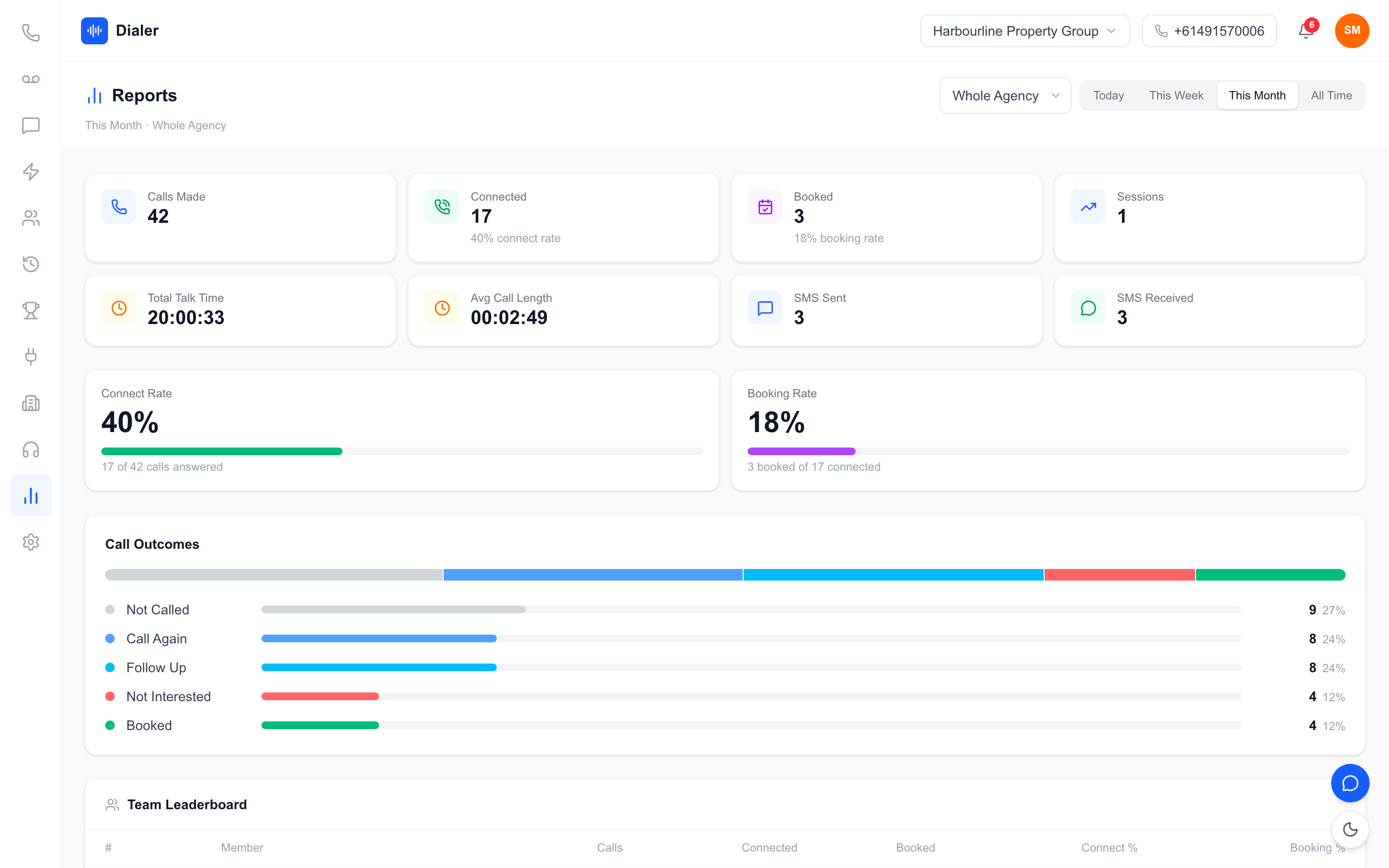
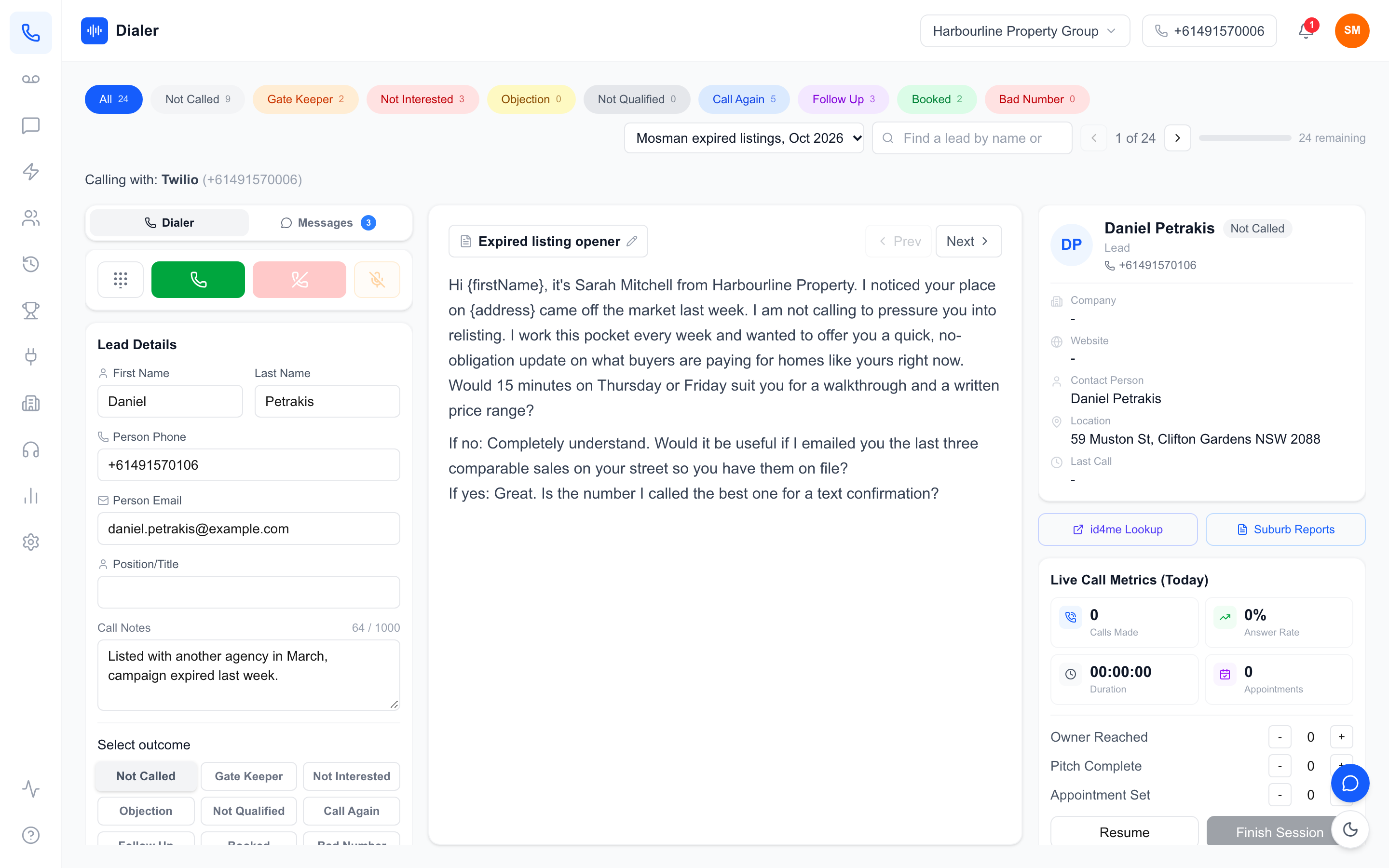
Veyce is a power dialler for Australian sales teams. In Power Dialler mode it rings one lead at a time, the rep marks an outcome when the call ends, and the next call starts. Live session metrics count calls and outcomes as the session runs, so nobody tallies calls on paper, and every session is kept in session history for the weekly review.
Leaderboards built on real activity
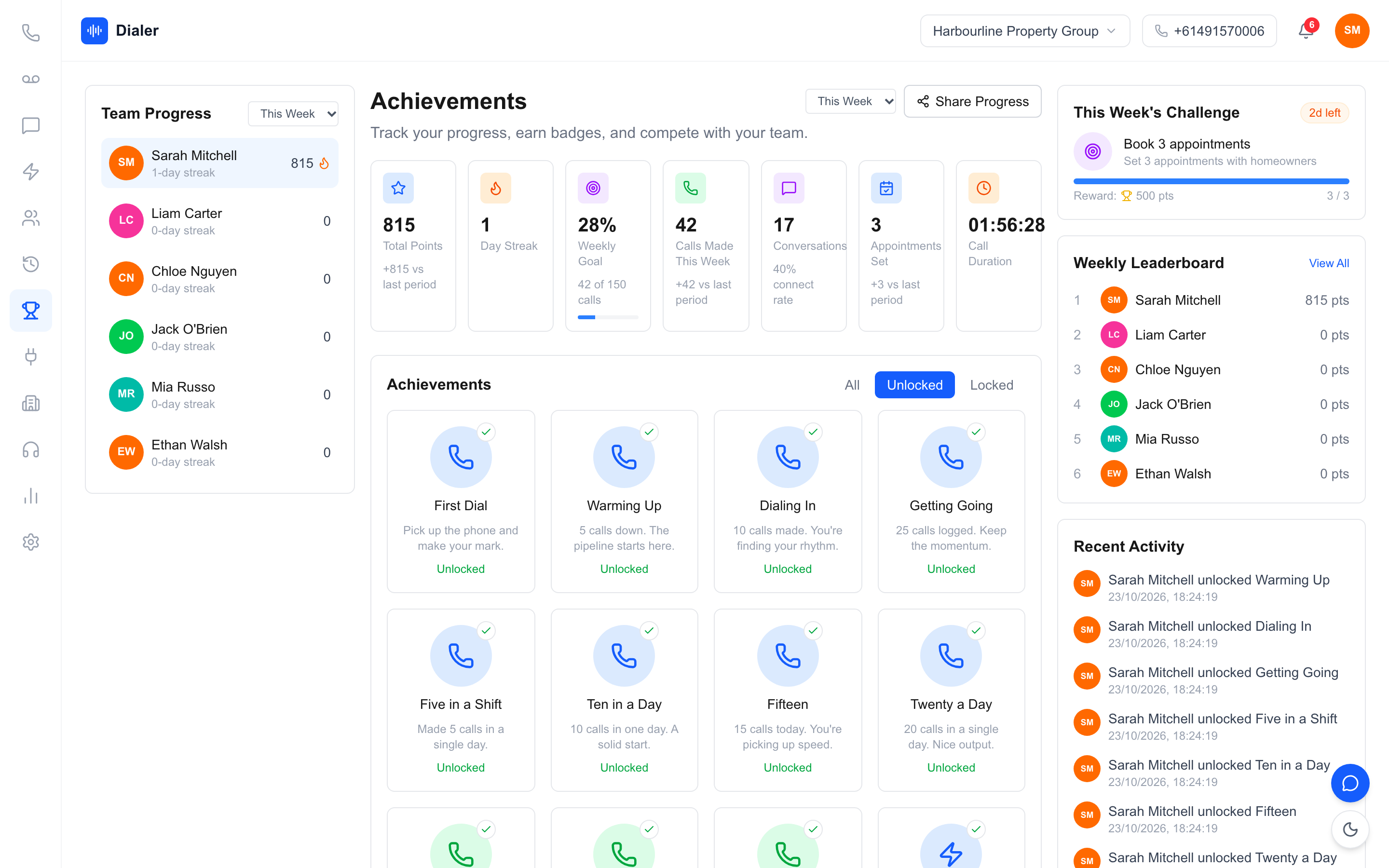
Leaderboards, points and streaks show the team's activity as it happens. Used well, they make the floor visible without a manager walking the room, and they reward steady daily calling over one heroic afternoon.
Minutes, seats and the free trial
Check a daily target against plan minutes as well as hours. Every plan includes a shared pool of outbound minutes: Solo at $49 a month has 1 seat and 100 minutes, Team at $179 has 4 seats and 400 minutes, Growth at $449 has 10 seats and 1,000 minutes, and Agency at $1,099 has 25 seats and 2,500 minutes. Extra seats on Team, Growth and Agency are $29 each, and top-up packs start at $30 for 100 minutes. The free trial runs for 3 days from your first call with 100 calling minutes and no card. See the plans and pricing page for the detail.
Conclusion: turn the number into a daily routine
A five-step recap
- Write down the monthly revenue target and average sale value for each rep.
- Use the last four weeks of outcomes to find your meeting, conversation and connect rates.
- Work backwards to dials and conversations per day.
- Check the result against real calling hours and a timed hour of dialling.
- Set a floor and a stretch, put conversations beside dials, and recalculate monthly.
Your next step
So, how many calls should a sales rep make a day? As many as your own sums say, and no more than your calling hours allow. If the sums ask for more dials than manual calling can deliver, the fix is a faster gap between calls, not a longer day. Veyce is a power dialler for Australian teams that counts calls and outcomes as reps work. Start a free trial and time your first real hour.
Frequently asked questions
How many calls should a sales rep make a day?
Enough to reach the revenue target at your own conversion rates. Work backwards: sales needed, meetings needed, conversations needed, then dials. In the worked example in this guide, a $40,000 monthly target comes out at about 80 dials and 16 conversations a day. Your figure will differ, because it depends on your sale value, your list quality and how many of your calls are answered.
Is 100 calls a day realistic for a sales rep?
It can be, if the rep has enough real calling time and a fast way to move between calls. Time one rep for one hour on a normal list, count the dials, and multiply by the calling hours that rep really has. If the result is well under 100, the target needs to change, or the gap between calls does. Longer, complex conversations also lower the realistic number.
Should call targets be based on dials or conversations?
Track both, and manage on conversations. Dials measure effort and are easy to inflate by ringing numbers that never answer. Conversations with the right person measure progress. A rep with 60 dials and 20 conversations has had a better day than a rep with 120 dials and 8. Putting conversations and bookings beside dials on the board removes the reward for gaming the count.
How does a power dialler change how many calls a rep can make?
A power dialler places the next call as soon as the rep records the outcome of the last one, which removes the time spent finding a number, typing it and writing up the result by hand. The rep's talk time stays the same; the gap between calls shrinks. That lifts the number of dials that fit into the same calling hours, without asking for a longer day.
How often should we review daily call targets?
Once a month is a sensible rhythm. Conversion rates move when the list source, the offer, the price or the script changes, and a target built on old rates quickly becomes too easy or impossible. Recalculate from the last four weeks of outcomes and show the team the working. Also review after any big change, such as a new product or a new lead supplier.